
The question comes up in almost every review. There's surplus cash each month, or a bonus has landed, and there are three obvious homes for it: the offset account against the mortgage, an investment portfolio, or extra contributions to super.
What makes this hard is that all three are reasonable. It isn't a case of one good option and two bad ones. And because everyone has a view — a colleague who swears by paying the house off, a friend who salary sacrifices everything — the decision tends to get made on instinct rather than arithmetic.
There is a cleaner way to think about it, and it starts with taking the offset account seriously.
Why the offset is a stronger competitor than it looks
Money sitting in an offset account reduces the balance your interest is calculated on. If your home loan rate is 6%, every dollar in the offset saves you 6% a year in interest.
Two things make that saving unusually valuable.
It's certain. Not expected, not long-run average — certain, for as long as the loan and the rate persist. No other option on the list can say that.
It's not taxed. You haven't earned income. You've avoided an expense. There is nothing for the ATO to assess. A 6% saving is a 6% saving whether you're on the 32% marginal rate or the 47% one.
That second point is the one people miss. An investment has to earn its return in the taxed world and hand some of it over. The offset doesn't.
Australian mortgage rates have historically sat somewhere between one and two percentage points above the official cash rate. With the cash rate at 4.35% following the RBA's August decision, that puts most owner-occupier rates in a range where the offset is a meaningful competitor — and worth checking, because the number that matters here is your rate, not the average.
The hurdle rate
The hurdle rate is the pre-tax return an investment must earn to leave you no worse off than putting the same money in the offset.
If the return is taxed as income each year, the arithmetic is straightforward. You need a return that, after your marginal rate, matches the loan rate:
Hurdle rate = loan rate ÷ (1 − your marginal tax rate)
At a 6% loan rate and a 39% marginal rate, that's 6% ÷ 0.61 = 9.84%. You'd need a pre-tax return of nearly 10% to break even against simply parking the money in the offset.
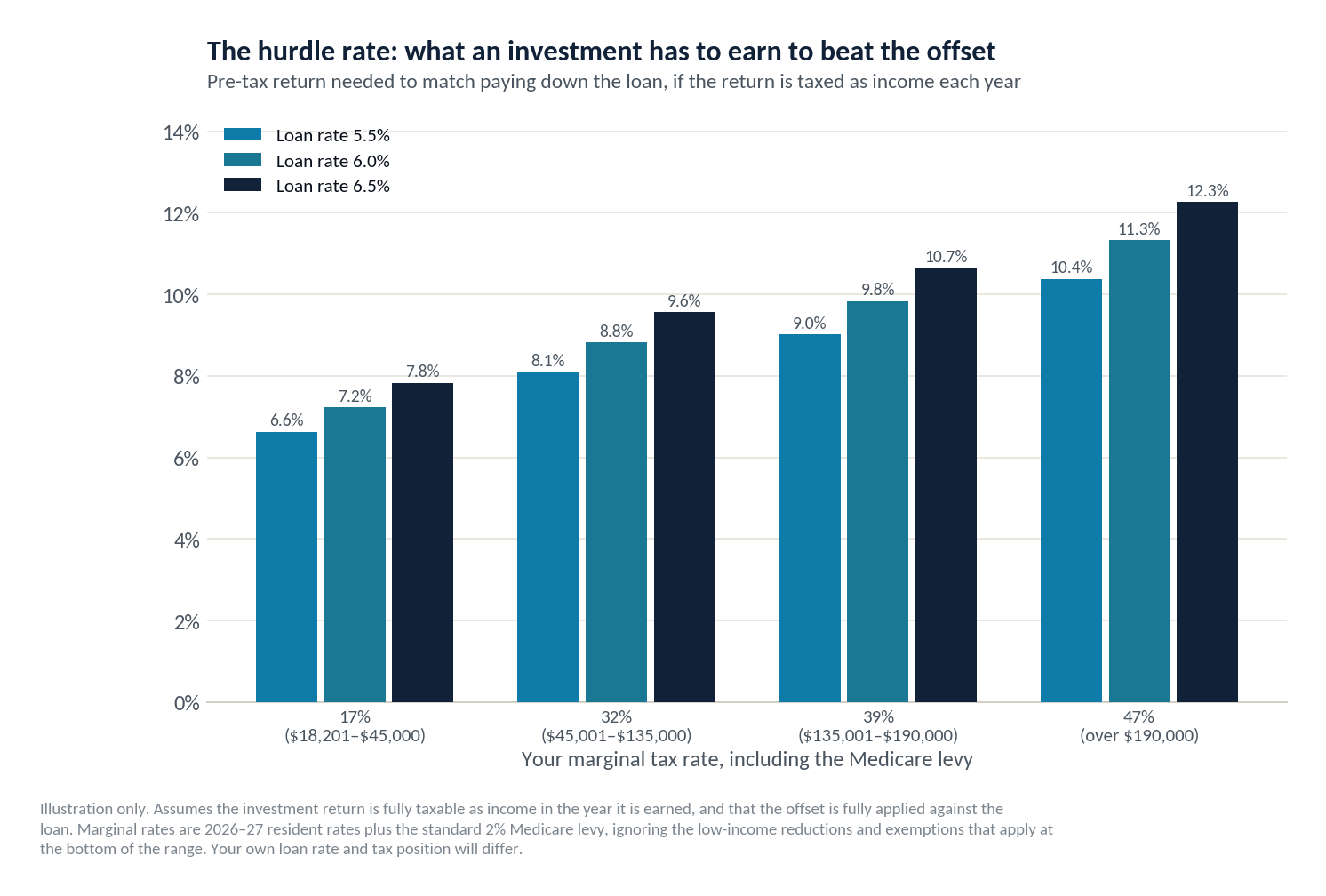
Two things stand out.
The hurdle rises with your tax rate. The higher your income, the harder an investment has to work to beat the offset — because the offset's advantage is that it sidesteps tax entirely, and the value of sidestepping tax grows with the rate you'd otherwise pay.
The numbers are demanding. At the top marginal rate with a 6.5% loan, the hurdle is over 12%. That is not a return you should assume from a diversified portfolio.
If the story ended there, the offset would win almost every time. It doesn't end there.
Why the type of return matters more than the size
The hurdle above assumes the worst case for the investment: that the whole return is taxed as income, every year, at your full marginal rate. Very few portfolios work that way.
Two features change the arithmetic materially.
Franking credits. When an Australian company pays a fully franked dividend, it has already paid 30% company tax. You're taxed on the grossed-up amount but credited for the tax already paid, and where the credit exceeds your tax bill it's refunded. That means the cash yield you need is lower than the raw hurdle suggests.
Deferral. Capital growth isn't taxed until you sell. Money that would otherwise have gone to the ATO each year stays invested and compounds. Over a long hold, that deferral is worth a great deal.
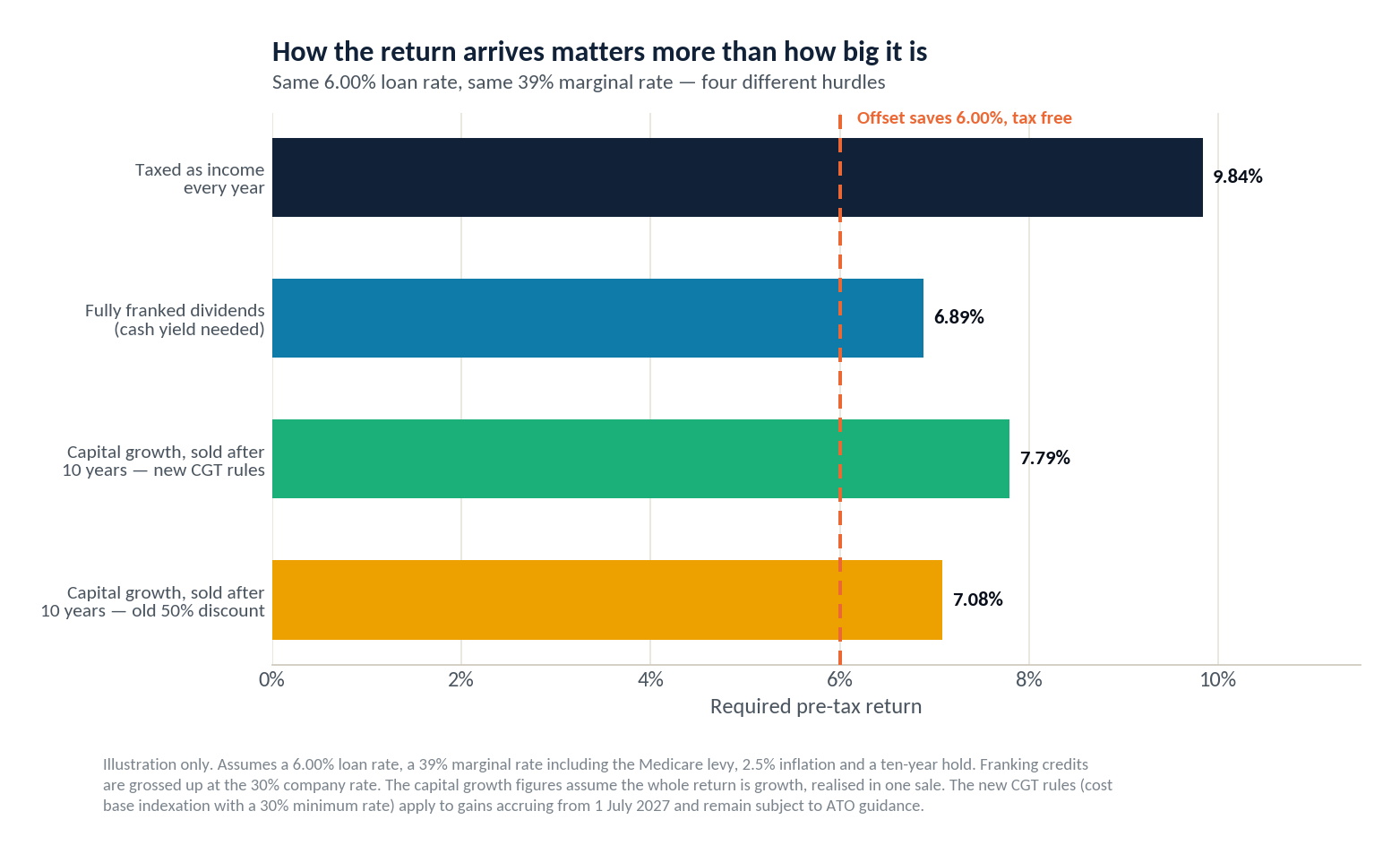
Same loan rate, same tax rate, four very different hurdles. A portfolio delivering fully franked income needs a 6.89% cash yield to match a 6% offset. One delivering pure capital growth over ten years needs 7.79%. The naive "taxed as income" figure of 9.84% is the outlier, not the norm.
The chart also shows something worth noting. Under the old 50% CGT discount, the growth hurdle was 7.08%. Under the new rules that apply to gains accruing from 1 July 2027 — cost base indexation with a 30% minimum rate — it's 7.79%. The reform raised the bar for growth assets held in personal names by roughly 0.7 of a percentage point. Not dramatic, but real, and in the offset's favour.
Where super's advantage actually comes from
Super is usually discussed in terms of its low tax rate on earnings — 15% in accumulation, nil on assets supporting a retirement pension. That's true, and it matters. But it isn't where most of the advantage sits.
The bigger effect happens before a single dollar is invested.
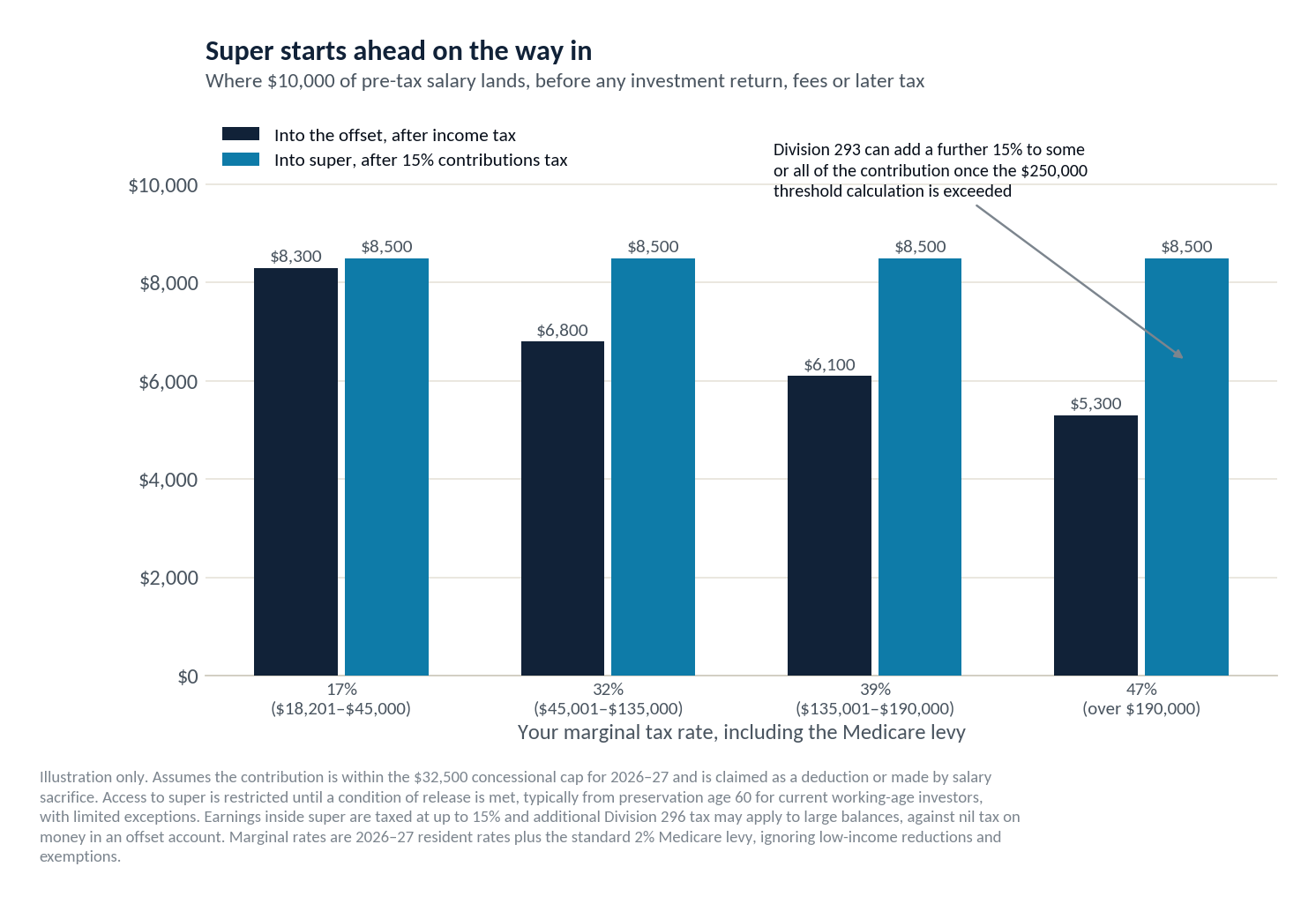
Take $10,000 of pre-tax salary. Direct it to the offset and you first pay income tax on it. On the 47% marginal rate, $5,300 arrives. Direct the same $10,000 into super as a concessional contribution and it's taxed at 15% going in, so $8,500 arrives.
Super starts with roughly 60% more capital in that example. That is a real advantage, and it is the strongest argument in super's favour.
It is worth being precise about what the chart shows, though. It shows a starting tax advantage, not an outcome. Whether super finishes ahead also depends on investment returns, fees, the tax paid on earnings along the way, Division 296 where it applies, your time horizon and whether the access restrictions cost you anything. Here's what sits on the other side:
- Access is heavily restricted. Super is preserved until you meet a condition of release — typically from preservation age 60 for anyone of current working age, though reaching 60 does not by itself make every balance unrestricted. There are limited exceptions, and the First Home Super Saver scheme allows some voluntary contributions to be released for a first home. For most purposes, though, it cannot be used to repay your loan or cover a redundancy. The offset can be drawn on tomorrow.
- There's a cap. Concessional contributions are limited to $32,500 in 2026–27, and that includes what your employer pays in. Carry-forward provisions may let you use unused cap from earlier years if your total super balance was under $500,000 at 30 June.
- The head start shrinks at lower tax rates. On the 32% marginal rate, $6,800 lands in the offset against $8,500 in super. Still an advantage, but a much smaller one.
- And it shrinks at very high incomes. Division 293 can apply a further 15% once your Division 293 income plus concessional contributions exceeds $250,000. It is not a cliff and it does not necessarily hit the whole contribution: the extra tax applies to the lesser of your taxable concessional contributions and the amount by which you exceed the threshold. Someone on $240,000 making $15,000 of contributions pays it on $5,000, not on all $15,000.
- Large balances now attract more tax. Division 296 took effect on 1 July 2026 and adds 15% to the taxable earnings attributable to a balance above $3 million, and a further 10% above $10 million. Most people are nowhere near it. If you are, it changes the arithmetic.
- The rules change. They have changed twice in the last two years.
Putting the three side by side
Offset account
- Return: certain, equal to your loan rate
- Tax on the return: none
- Tax going in: paid in full
- Access: immediate
- Limits: your loan balance
- Downside: the return falls if rates fall
Investing outside super
- Return: uncertain
- Tax on the return: your marginal rate, reduced by franking and deferral
- Tax going in: paid in full
- Access: a few days
- Limits: none
- Downside: you can lose capital
Super (concessional contributions)
- Return: uncertain
- Tax on the return: 15%, or 10% on long-held gains; nil in pension phase. Division 296 may add more on large balances
- Tax going in: 15%; Division 293 can add a further 15% to some or all of the contribution once the $250,000 threshold calculation is exceeded
- Access: restricted until a condition of release, typically preservation age 60
- Limits: $32,500 cap for 2026–27
- Downside: you can lose capital, and access is restricted
Reading across those three, the honest summary is this. The offset wins on certainty and access. Super wins on tax going in, substantially, but only if you can genuinely do without the money until a condition of release is met. Investing outside super sits between the two, and its case rests on flexibility and on the type of return it produces rather than on tax efficiency.
Where debt recycling fits
There's a fourth option worth naming, because it changes the terms of the question rather than answering it.
Debt recycling converts non-deductible home loan debt into deductible investment debt, without borrowing more. If it's done properly, the interest on the investment portion becomes deductible — which lowers the effective cost of the debt and, with it, the hurdle the portfolio has to clear.
It also introduces gearing risk and a set of administrative requirements that are unforgiving of mistakes. We've written about it separately, and it deserves its own conversation rather than a paragraph here.
What this means for you
A short framework rather than an answer:
- 1. Find your actual loan rate. Not the cash rate, not the advertised rate — the rate on your statement. Everything else follows from it.
- 2. Work out your marginal rate, including the Medicare levy. If you're near a bracket boundary, check which side you're really on. At lower incomes the levy is reduced or does not apply, so the bottom band in our charts is a simplification.
- 3. Calculate your hurdle. Loan rate divided by (1 minus your marginal rate). That's the number an investment has to beat if its returns are taxed annually.
- 4. Adjust for how you'd actually invest. Franked income and long-held growth both lower the hurdle materially. Be realistic, not optimistic.
- 5. Ask the access question honestly. Could you lock this money away until you meet a condition of release, typically age 60? If the answer is anything other than a clear yes, super's advantage is theoretical.
- 6. Check your emergency reserve first. Before any of this. Money in an offset does double duty as a buffer; money in super does none.
- 7. Don't assume it's all one or the other. Splitting surplus cash across two of the three is often more sensible than optimising into one.
The bottom line
The offset account is the quiet benchmark in this decision. It pays a certain, tax-free return equal to your loan rate, and at higher marginal rates the pre-tax return needed to beat it is higher than most people expect.
That doesn't make it the right answer. Super's contributions-tax advantage is substantial and hard to argue with, if you can accept the preservation rules. Investing outside super buys flexibility that neither of the others offers. The point of the hurdle rate isn't to pick a winner — it's to make the comparison honest, so the decision is based on arithmetic rather than on whoever spoke last.
Work out your own number. It's a five-minute calculation and it will tell you more than most of the advice you'll hear on the subject.
Speak with an adviser
If you're weighing up where surplus cash should go, or you're not sure how the three options interact with your longer-term plan, it may be worth reviewing your position before making changes. We model this properly rather than by rule of thumb, and we're happy to talk it through.
Important information
This article is general information only. It has been prepared without taking into account your objectives, financial situation or needs, and should not be relied on as personal financial or tax advice. All figures are illustrations based on stated assumptions, not projections, and assume smooth constant returns that do not occur in practice. Investment returns are uncertain and can be negative. Tax rates, contribution caps and superannuation rules change, and tax outcomes depend on your individual circumstances — we'd recommend speaking with your accountant or registered tax agent, as well as your financial adviser, before acting. FinPeak Advisers is a Corporate Authorised Representative (1249766) of Spark Advisors Australia (AFSL 380552).