
Covers August 2026 and September to 29 September 2026.
August was a steady month with one loud corner. Shares rose modestly at home and abroad, bonds did little, the Australian dollar firmed, and gold had its strongest month in some time. September answered one of the two questions hanging over it: the Reserve Bank did not stay on hold. The other, whether share prices have run ahead of the earnings behind them, is still open.

The Reserve Bank: a fourth increase for the year
On 29 September the RBA raised the cash rate by 0.25 percentage points to 4.60%, its fourth increase in 2026 after holding in June and August. The decision was unanimous. The Board said inflation “remains elevated and some of the upside risks flagged in August are materialising”, that labour market conditions “have eased broadly as expected”, and that housing prices “have fallen in most capital cities” with new housing loans down noticeably. It kept the door open: it will do what it considers necessary “including increasing the cash rate target further if needed”.
In August the Board had held at 4.35% while warning that headline inflation was “still too high”. The September move follows through on that warning.
The data since then has been mixed rather than decisive. Headline CPI eased to 3.5% in the year to July from 3.8% in June, but the trimmed mean, the measure the RBA watches most closely, was unchanged at 3.6%. Both remain above the 2–3% target band. Petrol prices rose 7.5% in the month as part of the fuel excise relief unwound, and new dwelling costs were up 5.7% over the year. The August CPI is due on 30 September.
The economy grew 0.4% in the June quarter and 2.1% over the year, with the ABS describing households as continuing “to behave cautiously”. Unemployment rose to 4.6% in August from 4.5% in July, even as employment increased by 39,500 and participation edged up to 67.1%. More people looking for work, and a slightly higher share not finding it, is consistent with the Board’s description of a labour market easing rather than breaking.
Shares: modest gains, with valuations doing the talking
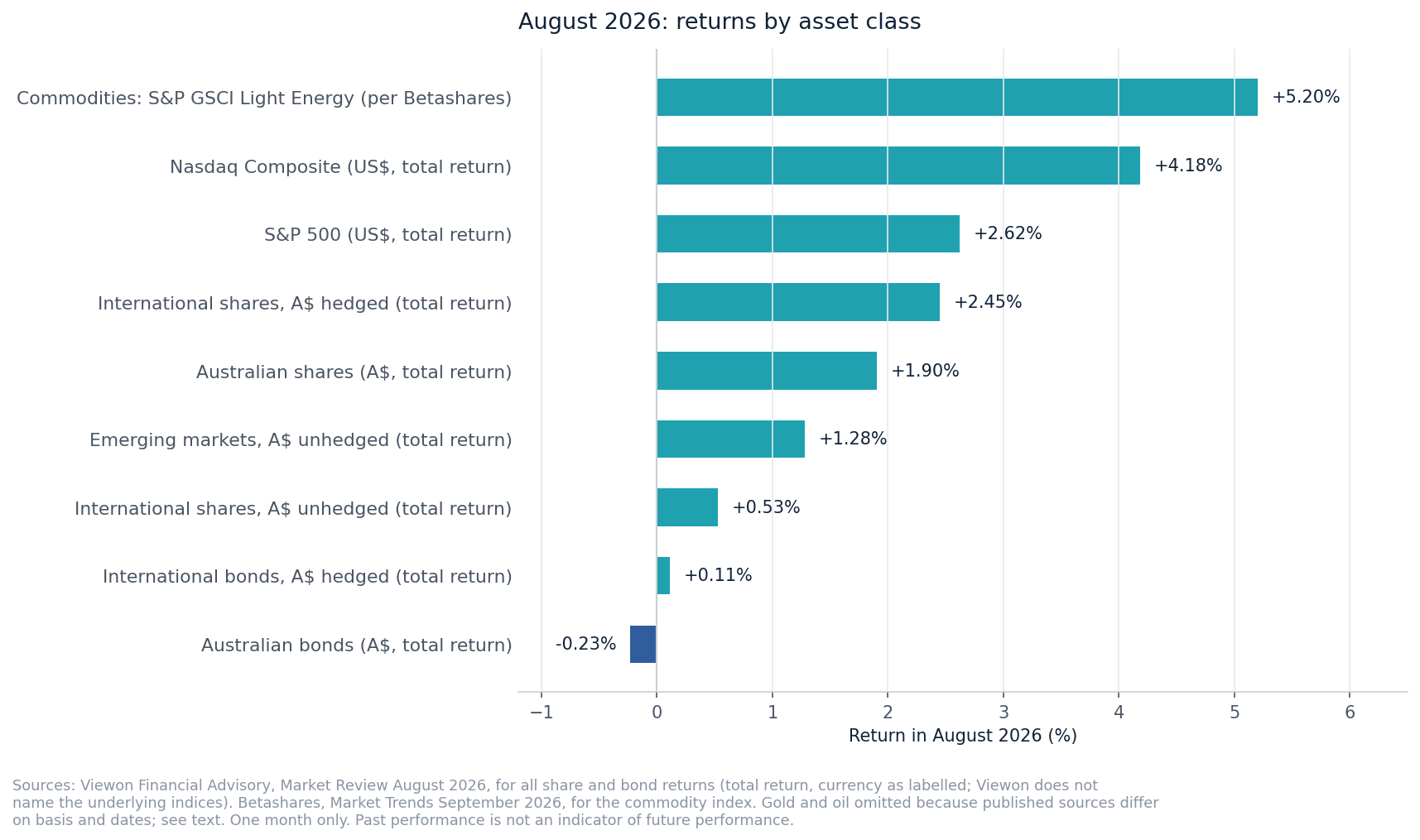
Global shares rose 2.7% in local currency terms in August, according to Betashares, though the stronger Australian dollar cut that to 0.7% for an unhedged Australian investor. US technology led the rebound after two weaker months: Viewon has the S&P 500 returning 2.62% and the Nasdaq Composite 4.18% in US dollar terms. Australian shares rose somewhere between 1.5% and 1.9% for the month: Betashares reports 1.5% without stating the index or whether dividends are included, and Viewon reports a 1.9% total return in Australian dollars. Either way it was a fifth consecutive monthly rise, with mining and healthcare strong and banks, consumer discretionary and listed property weaker.
The more useful story is in valuations and earnings rather than the monthly move.
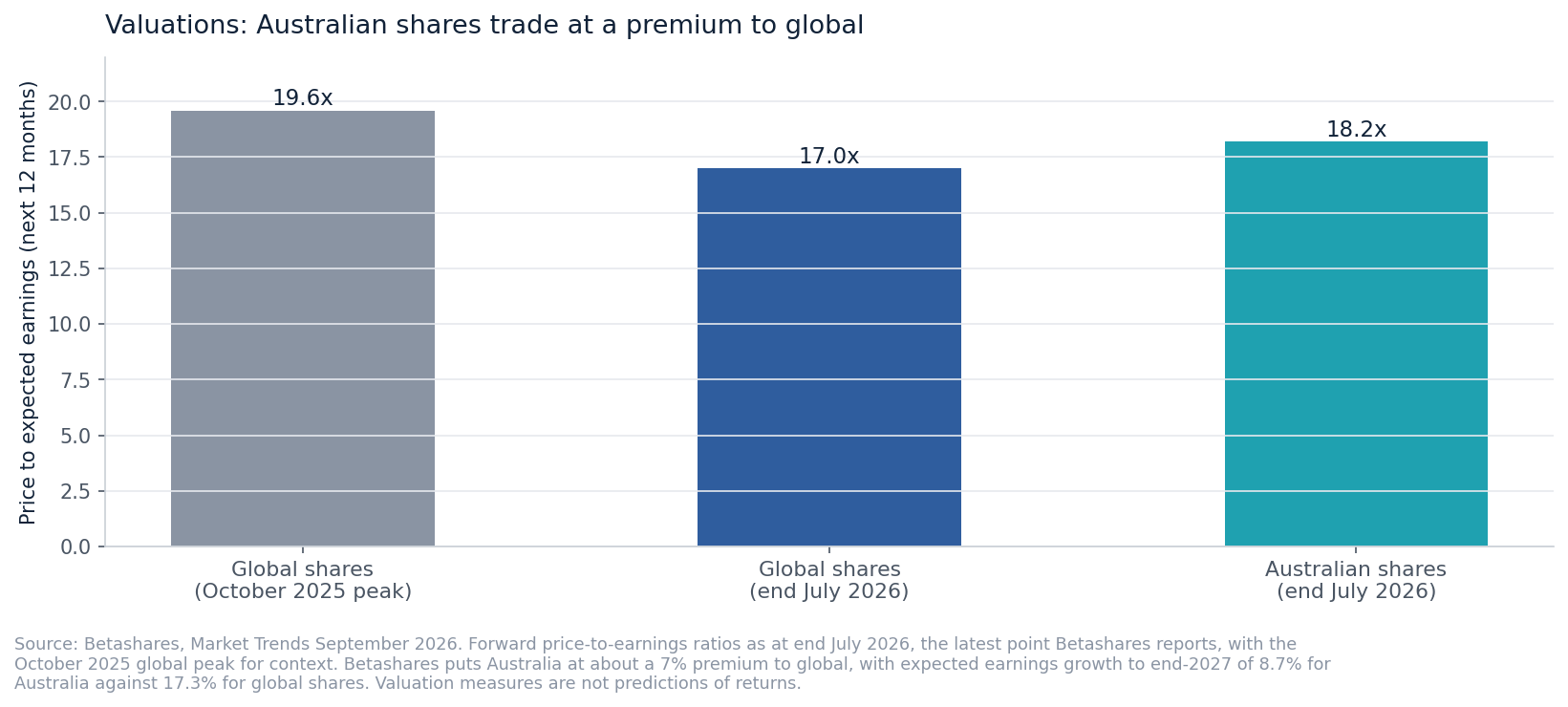
At the end of July, the latest point Betashares reports, global shares were on a forward price-to-earnings ratio of 17.0, down from a peak of 19.6 in October 2025, with analysts expecting earnings growth of 17.3% through to the end of 2027. Australian shares were on 18.2 times, a premium of about 7% to global on the same date, with expected earnings growth of 8.7% over the same period. In plain terms: Australian shares are dearer than global shares and expected to grow earnings more slowly.
Reporting season supported that caution. VanEck’s Cameron McCormack, writing on 1 September, found that only 24% of S&P/ASX 200 companies beat expectations during the August results, while the index still rose, and that forward earnings estimates have edged lower. That is a gap that can close either way, through earnings catching up or prices adjusting. It is a reason to be measured about Australian equity exposure, not a signal to act.
Bonds and rates: Australia’s yield premium widened

The Australian 10-year government bond yield rose 0.17 percentage points in August to 5.09%, while the US 10-year slipped to 4.71%. The gap between the two, about 0.38 percentage points in Australia’s favour, is part of why the Australian dollar firmed. Betashares noted at the time that markets were pricing one further rate increase in both Australia and the United States by year-end. Australia’s has now happened.
Bond returns for the month were close to flat: Australian bonds slightly negative as yields rose, international bonds slightly positive. At current yields, high-quality bonds pay more income than they did for most of the past decade.
Currency and commodities
The Australian dollar rose 2.1% against the US dollar to about 71.6 US cents, and 1.4% on a trade-weighted basis. For an investor holding unhedged global shares, that is why a 2.7% global return became 0.7% in Australian dollar terms, and why Viewon’s hedged international share return of 2.45% was well ahead of its unhedged 0.53%. Currency moves both ways; hedging is a portfolio-level decision rather than something to react to month by month.
Gold prices rose 9.7% in August on Betashares’ figures, the strongest of the major assets for the month; other published reviews show a larger gain depending on the currency and dates used. The S&P GSCI Light Energy commodity index rose 5.2% after a 6.1% gain in July, with copper supported by demand from AI infrastructure and clean energy. Brent crude rose between about 1% and 3% in August depending on the source.
What we are watching
- What the rate rise does to borrowers and housing. The Board itself notes prices falling in most capitals and new lending down; a fourth increase adds to that.
- The gap between prices and earnings in Australian shares. Whether earnings estimates stabilise or keep drifting lower.
- The August CPI on 30 September. Australia now publishes a complete monthly CPI, so the August trimmed mean is the first test of whether the upside risks the Board cited are still building.
- Housing. Falling prices in some capitals alongside higher rates affect borrowers and would-be buyers differently.
- Private markets. Private credit continues to attract both money and scrutiny. We will cover the structural questions, liquidity, valuation frequency and transparency, in a coming issue.
What this means for you
A month like August rewards not doing very much, and a rate rise in September does not change that. The portfolio questions worth asking are structural:
- Is your Australian share exposure a deliberate weighting or the result of drift?
- Does your fixed income allocation reflect that bonds now pay a real income, or is it still set for a zero-rate world?
- If you hold global shares, is your currency exposure a decision you have made or one you have inherited?
- Is your cash buffer sized for a period of higher rates and cautious growth?
The bottom line
Inflation is easing but not fast enough for the RBA, which has now raised the cash rate to 4.60% and left a further increase on the table. Growth is subdued and unemployment has drifted up to 4.6%. Share markets rose modestly in August, with Australian shares looking fully priced against expected earnings. None of it argues for a change of course; it argues for checking that your course was set deliberately, and that your cash flow can carry another 0.25 percentage points.
Speak with an adviser
If this affects you, it may be worth reviewing your position before making changes. We can look at whether your portfolio’s mix still matches your plan.
Important information
This article is general information only, current as at 29 September 2026. It has been prepared without taking into account your objectives, financial situation or needs. Before acting on any information, consider whether it is appropriate for you and seek advice tailored to your circumstances. Market figures are as published by the sources named and have not been independently verified; fund manager commentary is a guide only and does not represent FinPeak’s view. Past performance is not an indicator of future performance. Nothing in this article is a forecast. FinPeak Advisers ABN 20 412 206 738 is a Corporate Authorised Representative No. 1249766 of Spark Advisors Australia Pty Ltd ABN 34 122 486 935 AFSL No. 380552 (a subsidiary of Spark Financial Group ABN 15 621 553 786).
Sources: RBA, Statement by the Monetary Policy Board, 29 September 2026 (media release 26-27) and 11 August 2026; ABS, Consumer Price Index July 2026 (26 August 2026); ABS, National Accounts June quarter 2026 (2 September 2026); ABS, Labour Force August 2026 (24 September 2026); Betashares, Market Trends: September 2026 (David Bassanese) — equity return index and basis not stated, commodities S&P GSCI Light Energy, forward P/E figures as at end July; Viewon Financial Advisory, Market Review – August 2026 — total returns in the currency stated, underlying indices not named; VanEck, Cameron McCormack, 1 September 2026, on S&P/ASX 200 reporting season.