
Covers September 2026 and the September quarter. As at 13 October 2026.
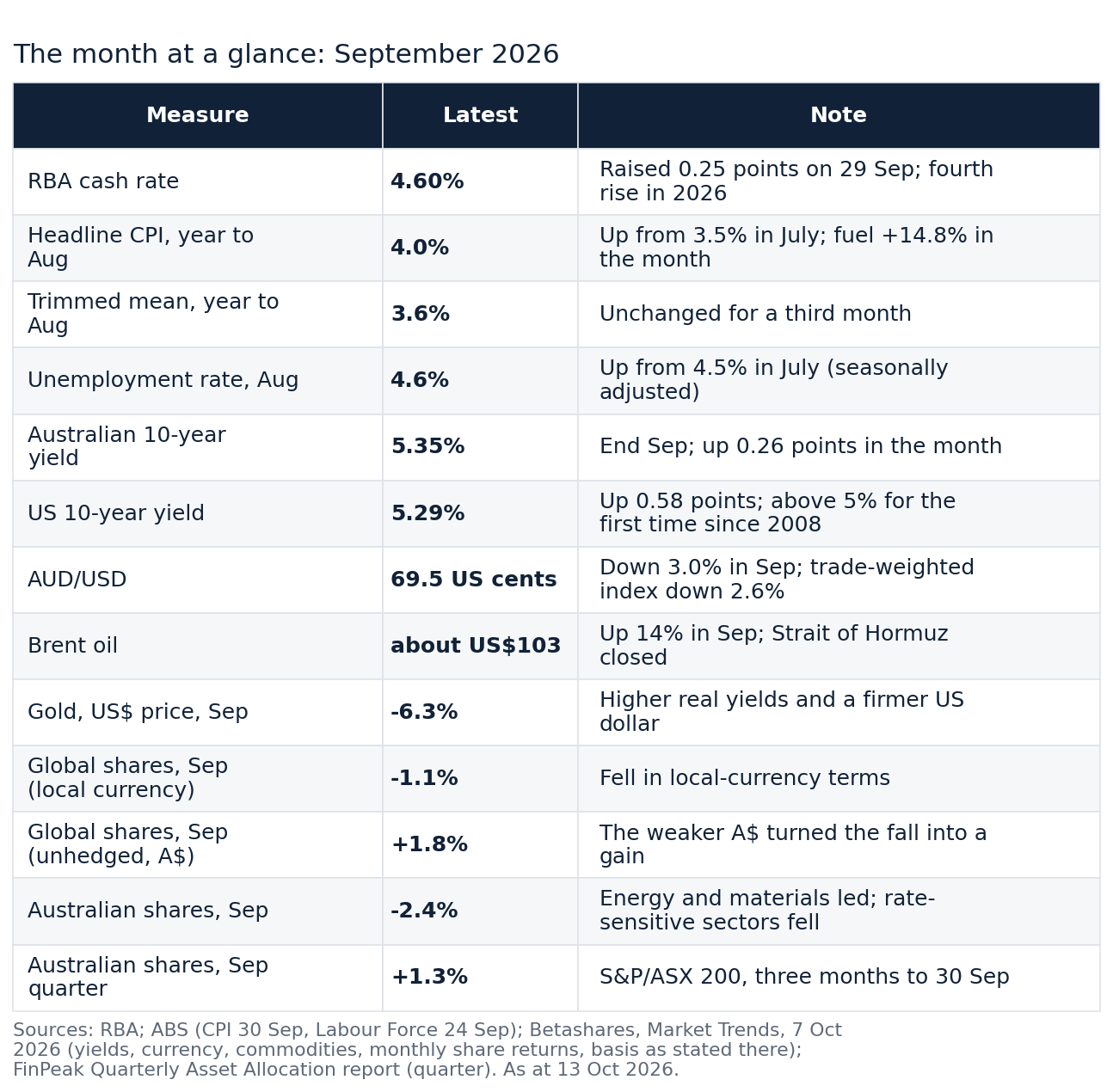
September put renewed pressure on fixed-rate bonds. The US 10-year Treasury yield closed above 5% for the first time since 2008, Australia’s 10-year reached 5.35%, and four of the world’s major central banks, including ours, raised rates in the same quarter. Shares finished the quarter higher but not comfortably, the Australian dollar fell, and oil jumped. Our quarterly asset allocation review landed in the middle of it and recommended no changes. This update covers what moved and why that was the decision.
Bond yields: the highest in a generation
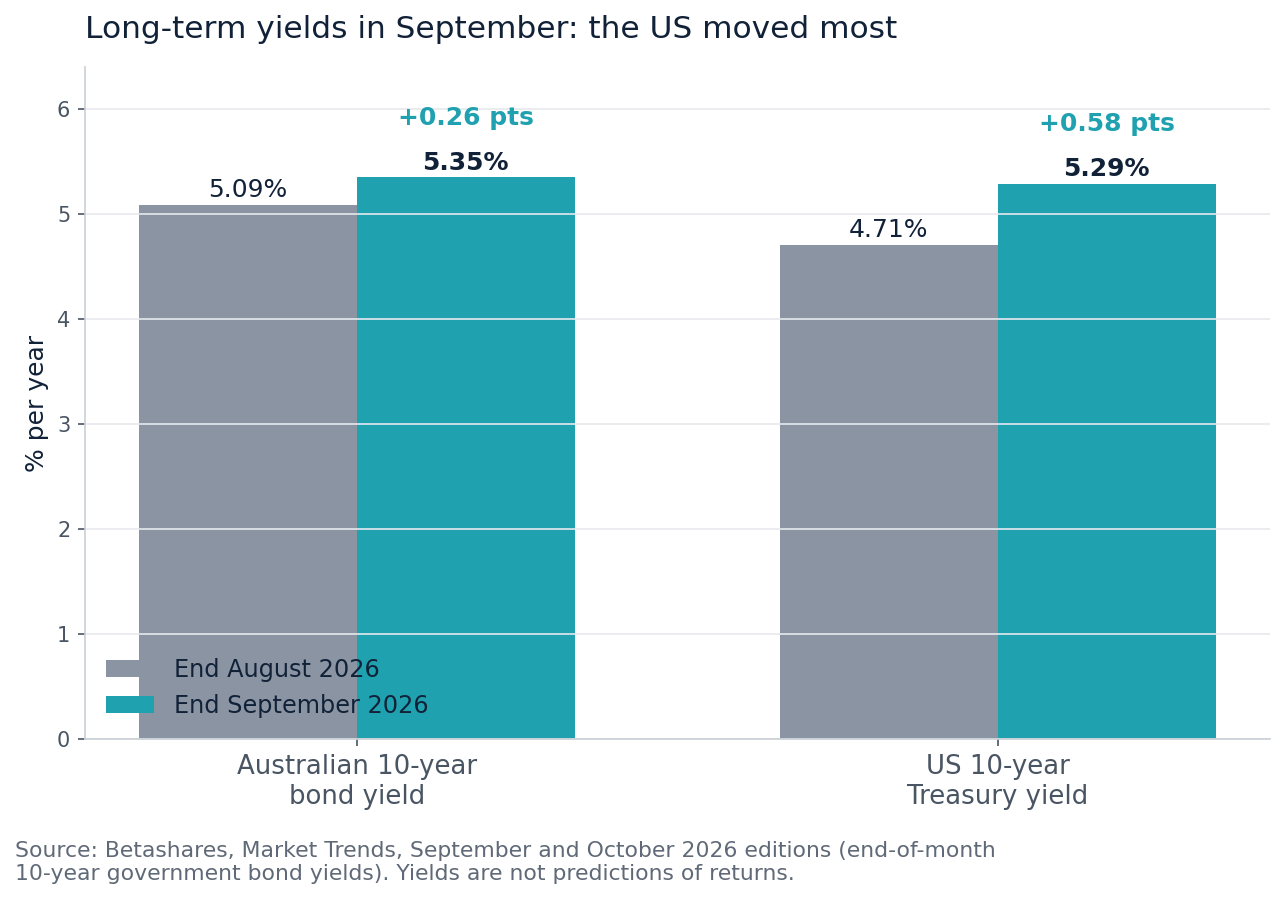
For most of the past four decades, long-term bond yields trended down. September extended a move in the other direction. The US 10-year yield rose 0.58 percentage points in the month to 5.29%, and the Australian 10-year rose 0.26 points to 5.35%. Macquarie describes global 10-year yields as having “broken out of a multi-decade decline”. The drivers are not mysterious: inflation that has stayed above target, resilient growth, heavy government borrowing, and an oil shock from the closure of the Strait of Hormuz layered on top.
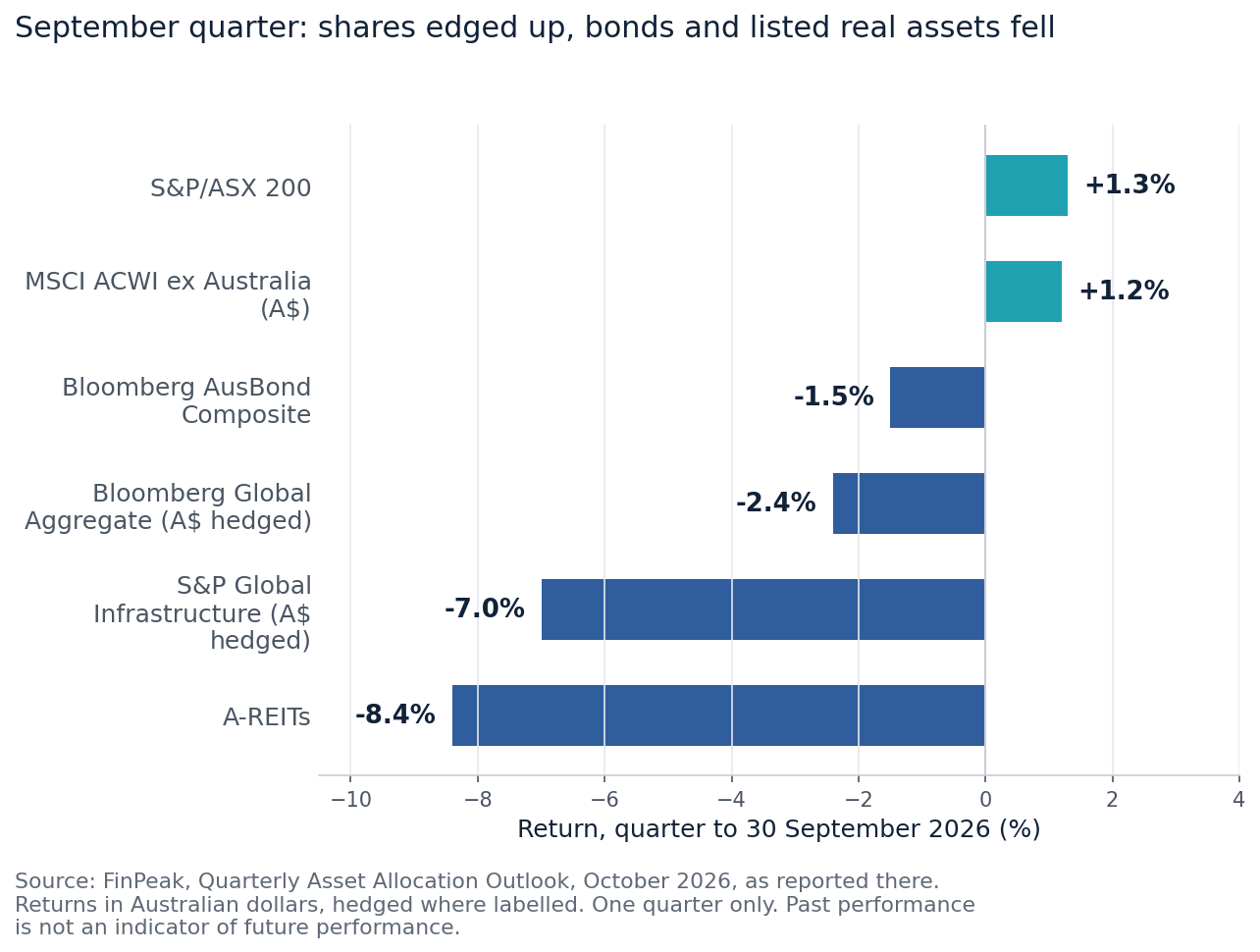
For bond investors that meant a difficult quarter. The Bloomberg AusBond Composite index fell 1.5% and the Bloomberg Global Aggregate index (hedged) fell 2.4%. Floating-rate credit, which has less sensitivity to interest-rate changes but remains exposed to credit and liquidity risk, returned 1.2% on the measure used in our quarterly report. Our defensive sleeve is built to carry less interest-rate risk than a bond index, and we come back to why below.
Central banks raised again
The RBA raised the cash rate to 4.60% on 29 September, its fourth increase this year. The August inflation data released the next day showed why: headline CPI rose to 4.0% over the year, up from 3.5% in July, driven by housing and a 14.8% jump in fuel prices in the month as the last of the federal fuel excise relief ended. The trimmed mean, which strips out the most volatile items, held at 3.6% for a third month. Both are above the 2–3% target band.
The US Federal Reserve raised rates in September for the first time in more than three years, and the European Central Bank and Bank of Japan tightened too. As at 7 October, Betashares put the market-implied cash rate a year ahead at about 4.9%, roughly one more increase, with about a 20% chance of a move at the 2–3 November meeting. That is market pricing on one date, not a prediction. Unemployment was 4.6% in August, up from 4.5%; Macquarie reads the RBA as wanting it closer to 5% before it is satisfied.
Shares: earnings carried, valuations compressed
Global shares fell 1.1% in September in local currency terms, but a 3% fall in the Australian dollar turned that into a 1.8% gain for an unhedged Australian investor. For the quarter, the MSCI All Country World ex Australia index was up 1.2% in Australian dollar terms. Higher real yields weighed most on long-duration growth stocks; value and quality held up better.
Australian shares fell 2.4% in September and returned 1.3% for the quarter. Leadership was narrow: energy and materials led over the year, while technology, consumer discretionary and listed property fell. The market rewarded commodity exposure and punished anything sensitive to interest rates or the domestic consumer.
The valuation picture matters more than the monthly move. Betashares has global shares on a forward price-to-earnings ratio of 16.2, down 4% in the month, and Australian shares on 17.6, a premium of about 9% to global. Earnings expectations make that premium harder to justify: analysts expect global forward earnings to grow about 17% by the end of 2027, driven by companies supplying the AI build-out, against about 8% for Australia. If tighter policy slows growth enough to erode the return on AI capital spending, those earnings expectations could be revised down.
The dollar did more to global returns than the shares did
The Australian dollar fell 3.0% against the US dollar in September to about 69.5 US cents, and 2.6% on a trade-weighted basis, as US yields rose faster than ours. For anyone holding global shares unhedged, currency was the biggest single contributor to the month’s return. That is not a reason to react; it is a reason to know whether your currency exposure is a decision you have made or one you have inherited.
Oil, gold and the Strait
Brent crude rose 14% in September to around US$103 a barrel as the Strait of Hormuz remained closed and temporary buffers (strategic reserves, inventory drawdowns, demand management) kept depleting. Price pressure has migrated into refined products such as diesel and jet fuel, which is why it is showing up in transport and freight costs. Gold fell 6.3% in US dollar terms as higher real yields and a stronger US dollar weighed on it; the small gold allocation across our models is held as a diversifier, not a return driver.
Oil is the swing factor for much of the above. A supply agreement that reopens the Strait would ease inflation and weaken the case for further tightening. A prolonged stalemate would do the opposite.
What the quarterly review decided
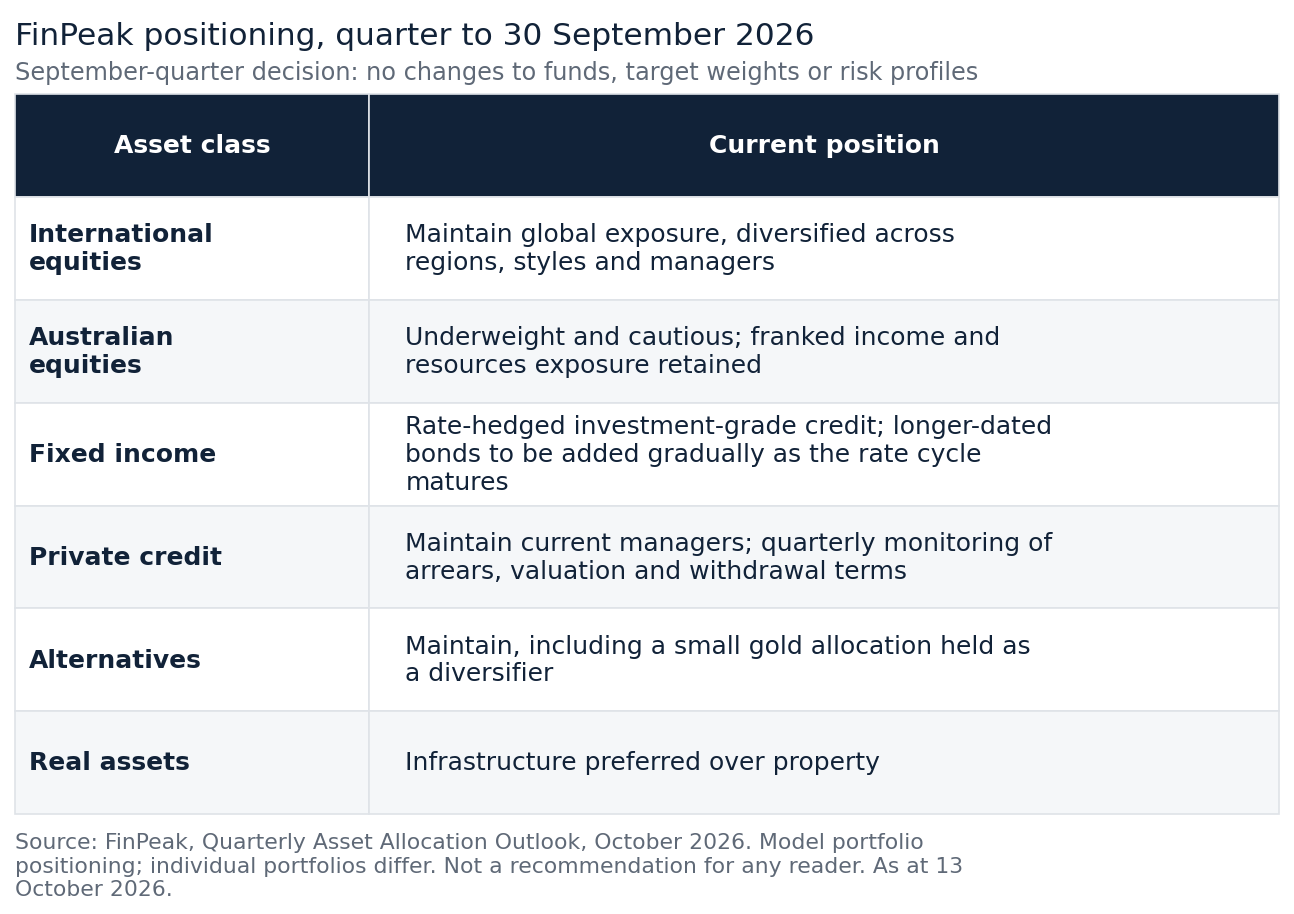
Our September-quarter asset allocation review recommended no changes to funds, target weights or risk profiles. The full report, including the research-house views it draws on, is here: Download the FinPeak Quarterly Asset Allocation Outlook, October 2026 (PDF). The reasoning, in brief:
- Global over Australian shares. Both research houses we draw on, Macquarie and BlackRock, prefer global equities to Australian on the earnings outlook. We maintain global exposure and stay underweight Australian shares, which still provide franked income and resources exposure but look fully priced against expected earnings.
- Rate-hedged credit over long bonds, for now. Income is back: BlackRock estimates about 84% of a broad global bond universe now yields more than 4%, compared with almost nothing in mid-2020. Macquarie’s fixed income team does not yet see sovereign bonds as a safe haven while yields are still rising. Our defensive sleeve is built from rate-hedged Australian investment-grade credit and floating-rate private credit, which carry less interest-rate risk than a bond index but do carry credit and liquidity risk. Our intention is to add longer-dated bonds gradually as the tightening cycle matures, not before.
- Infrastructure over property. Listed infrastructure fell with bond prices in the quarter, but its contracted cash flows and inflation pass-through, plus the demand for power and data centres from the AI build-out, keep it preferred over real estate.
- Participate, do not add. The AI earnings cycle is real and the portfolios already hold it. After a long run, the case is for diversification across regions, styles and managers rather than more broad equity exposure.
What we are watching
- The RBA on 3 November, and the September-quarter CPI in late October that will inform it.
- Oil. Whether the Strait reopens, or buffers run out and second-round inflation builds.
- AI earnings. Whether 2027 upgrades hold as rates rise and hyperscaler capital spending keeps being funded.
- The US midterm elections on 3 November.
- Private credit. Dispersion between managers is widening. Our monitoring of arrears, liquidity terms and research ratings continues; there is more on this in a separate article this month.
The bottom line
Bond yields have reset to levels not seen in a generation, central banks have tightened again, and share markets have so far been carried by earnings rather than valuations. None of it argued for changing course this quarter, and we did not. It does argue for checking that your portfolio’s mix was set deliberately: that your defensive assets are doing a defensive job, that your global exposure is diversified rather than concentrated in one theme, and that your cash flow can carry one more rate rise.
Speak with an adviser
If this affects you, it may be worth reviewing your position before making changes. We can look at whether your portfolio’s mix still matches your plan, and walk through what the quarterly review means for your accounts.
Important information
This article is general information only, current as at 13 October 2026. It has been prepared without taking into account your objectives, financial situation or needs. Before acting on any information, consider whether it is appropriate for you and seek advice tailored to your circumstances. Market figures are as published by the sources named and have not been independently verified. Views attributed to Macquarie Wealth Management and the BlackRock Investment Institute are theirs, summarised in FinPeak’s Quarterly Asset Allocation report, and may differ from FinPeak’s positioning. Market pricing and research-house expectations referred to in this article are attributed expectations, not FinPeak predictions, and may not eventuate. Past performance is not an indicator of future performance. FinPeak Advisers ABN 20 412 206 738 is a Corporate Authorised Representative No. 1249766 of Spark Advisors Australia Pty Ltd ABN 34 122 486 935 AFSL No. 380552 (a subsidiary of Spark Financial Group ABN 15 621 553 786).
Sources: Betashares, Market Trends: October 2026 (David Bassanese, 7 October 2026) — September figures and market pricing of the cash rate; equity return index and basis not stated, global equities in local currency, commodities S&P GSCI Light Energy; FinPeak, Quarterly Asset Allocation Outlook, October 2026 (quarter to 30 September 2026) — quarterly index returns (MSCI All Country World ex Australia, S&P/ASX 200, Bloomberg AusBond Composite, Bloomberg Global Aggregate hedged, S&P Global Infrastructure hedged, A-REITs), floating-rate credit return as reported, positioning, and Macquarie Wealth Management and BlackRock Investment Institute views as summarised there; RBA, Statement by the Monetary Policy Board, 29 September 2026; ABS, Monthly CPI August 2026 (30 September 2026); ABS, Labour Force August 2026 (24 September 2026); RBA, 2026 Monetary Policy Board meeting dates.