Markets had a comparatively quiet month in June, at least on the surface. Interest rates were left unchanged, share prices moved modestly higher, and some of the geopolitical tension that had been unsettling energy markets began to ease. But a calm headline number doesn't always tell the full story — here's what sat underneath it, and what we're watching from here.
The month in one chart
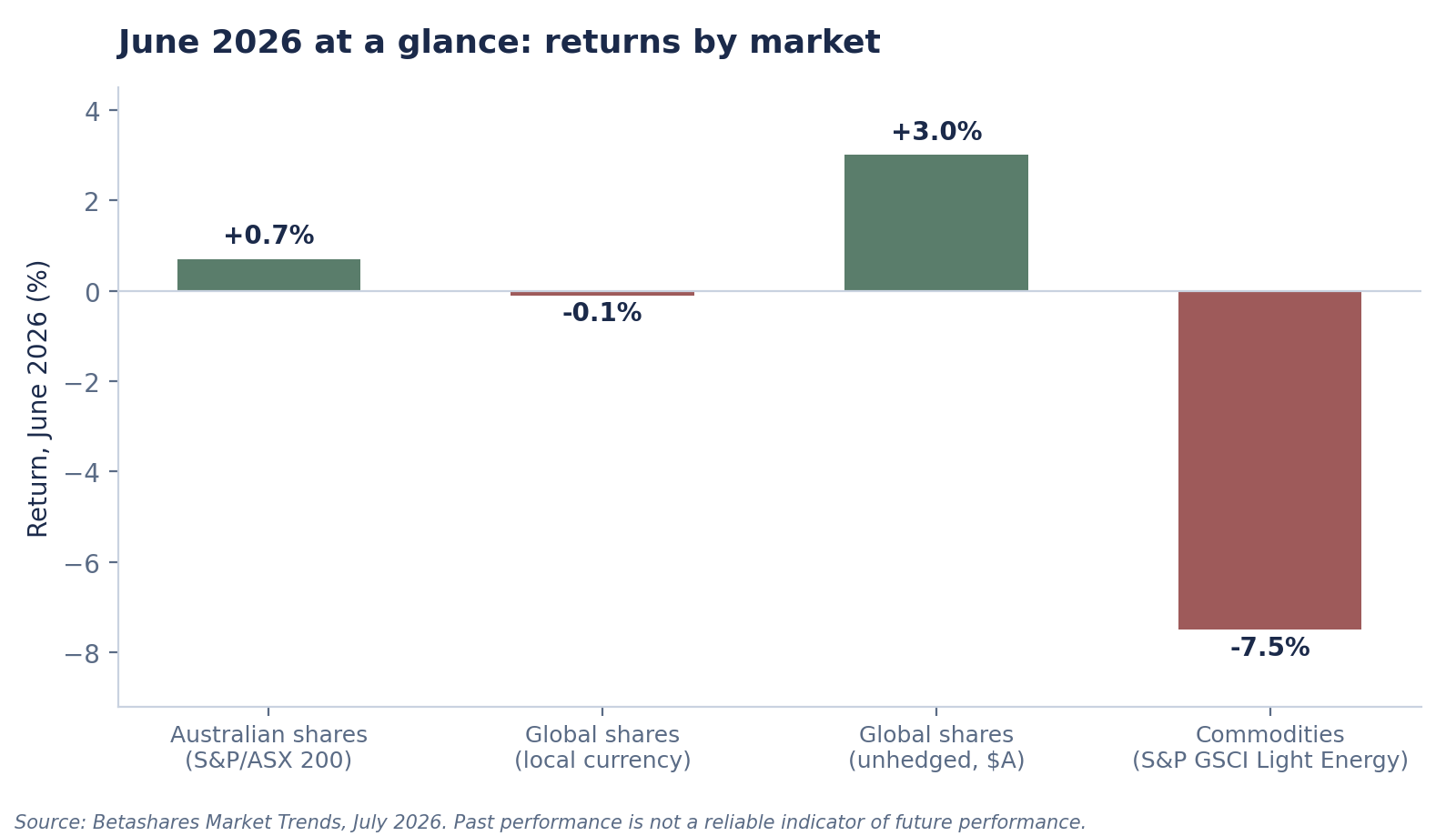
Three things stand out. Australian shares posted a modest gain. Global shares were flat in their own currencies, but a weaker Australian dollar meant unhedged global holdings returned around 3% for Australian investors — a reminder that currency can matter as much as markets in any given month. And commodity prices fell sharply, driven by growing optimism about a US–Iran peace deal, which pulled oil prices down and took gold, industrial metals and agricultural prices with them.
Interest rates: held steady, but not because inflation is resolved
The Reserve Bank's Monetary Policy Board met on 15–16 June and voted unanimously to leave the official cash rate unchanged at 4.35%. This followed three separate rate increases earlier in the year, in response to inflation running hotter than expected.
The Board's own explanation for holding steady was less about inflation being under control, and more about wanting to assess the impact of those earlier increases before moving again. The RBA specifically noted that headline and underlying inflation remain too high, and that it continues to watch for signs that price pressures are becoming embedded, particularly given the flow-through from higher oil prices earlier in the year.
In plain terms: this was a pause, not a pivot. The RBA's own statement left the door open to further increases "if required," which is worth keeping in mind if you're making decisions based on an assumption that rate rises are finished.
Interestingly, markets ended June expecting slightly less tightening in Australia than before — softer local data, including a weak March quarter GDP result and easing headline inflation, trimmed rate-rise expectations here, even as expectations of further hikes firmed in the United States after a strong US jobs report and some pointed commentary from the Federal Reserve.
The next scheduled RBA decision is at the Board's 10–11 August meeting, shortly after the June quarter inflation figures are released by the ABS on 29 July. That inflation print is likely to be the single most important data point shaping the RBA's next move.
Bond yields: the gap between Australia and the US narrowed
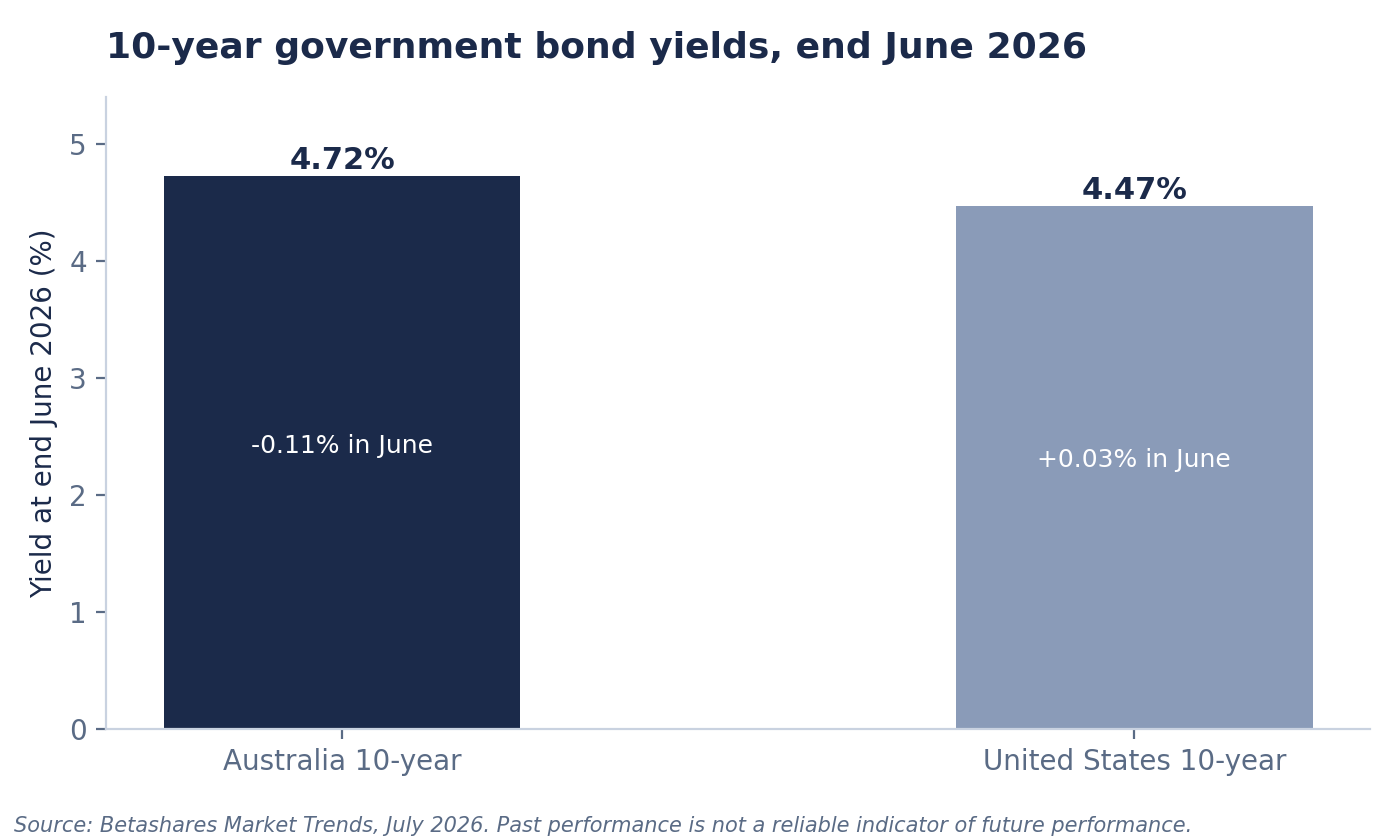
Australian 10-year government bond yields eased 0.11% over June to 4.72%, while US 10-year yields edged up slightly to 4.47% — narrowing the gap between the two. That divergence reflects the shift described above: markets pricing a little more tightening in the US, and a little less here. Yields in both markets have been drifting higher since late 2025 as expectations moved from rate cuts to rate rises.
The dollar: softer against a firmer greenback
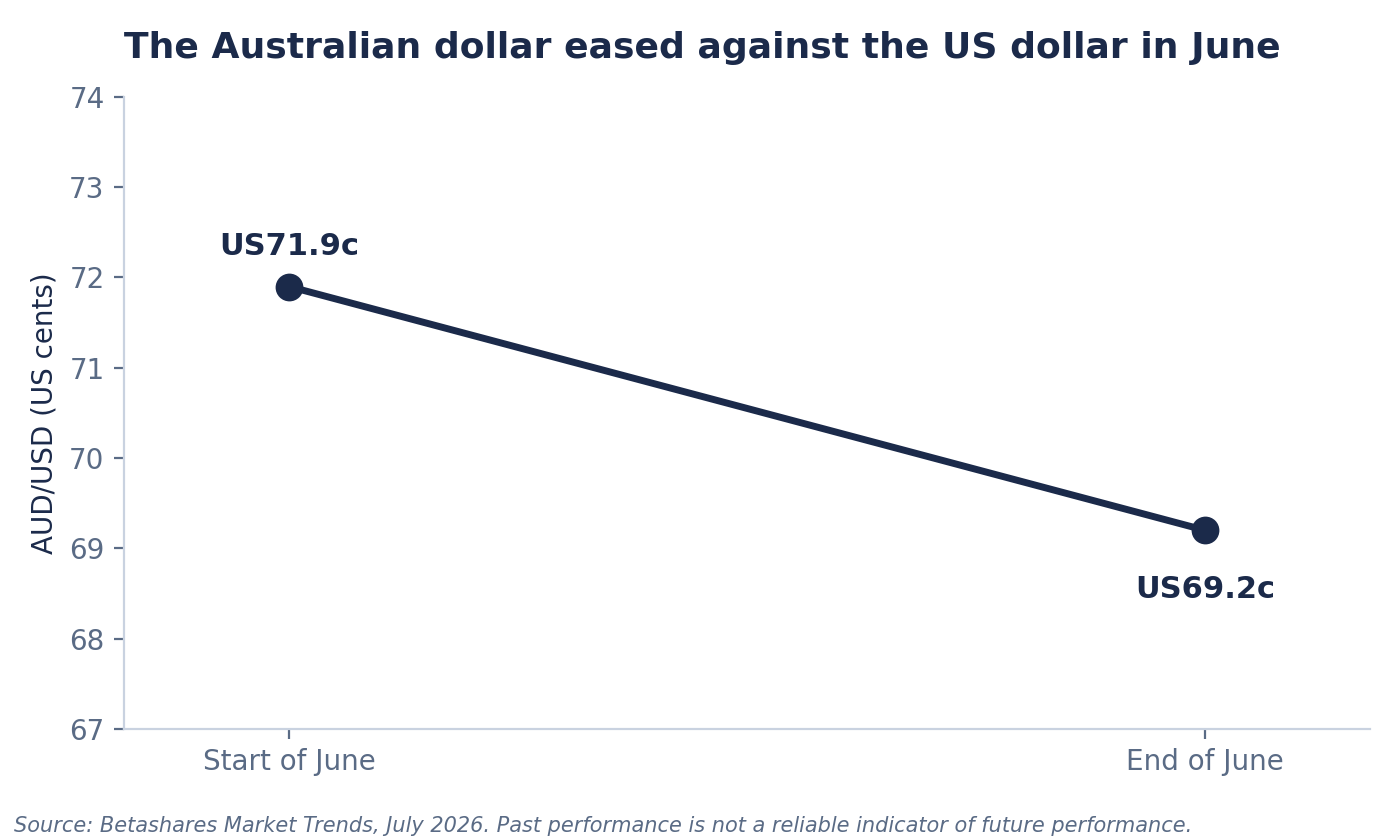
The Australian dollar fell from US71.9 cents to US69.2 cents over the month, largely a story of US dollar strength as American rate-rise expectations firmed. For unhedged international investments, that fall boosted returns in Australian dollar terms this month. Currency moves cut both ways, of course — which is why the hedged/unhedged mix in a portfolio is a deliberate setting rather than an afterthought.
Australian shares: higher in June, but still lagging the world
The S&P/ASX 200 returned 0.7% in June, following a 1.1% gain in May — its third consecutive monthly rise. Beneath the surface, the picture was uneven: sectors tied to commodity prices, along with technology, had a harder month as oil fell and some of the enthusiasm around AI-related shares globally cooled, while financials and health care held up better.
Zooming out, the picture for the 2025–26 financial year as a whole is more subdued. The ASX 200's total return for FY26 came in well below its long-run average, and the local market lagged most major global share indices over the period. Part of the explanation is earnings: market analysts currently expect around 3% growth in Australian company earnings by year-end, roughly half what's expected globally. This isn't a cause for alarm — markets go through periods of relative under- and over-performance as a matter of course — but it's a useful reminder not to assume the Australian market's experience mirrors what's happening globally.
Valuations: cheaper than they were
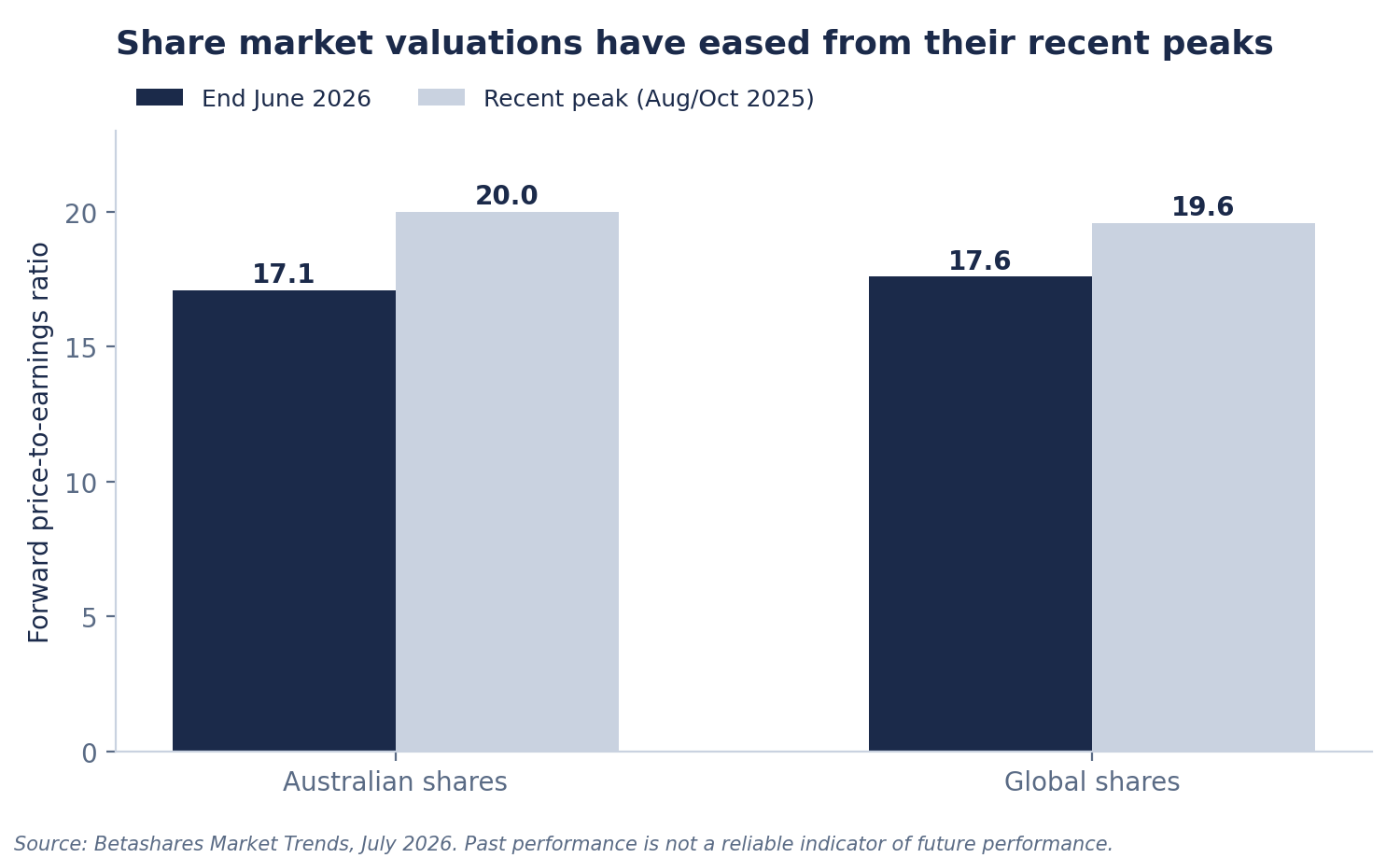
One quiet development worth noting: even as share prices have risen, valuations have become less stretched. The forward price-to-earnings ratio — what investors are paying today for each dollar of expected earnings — ended June at 17.1 for Australian shares and 17.6 for global shares, both down meaningfully from their peaks last year. That's happened because company earnings expectations have grown faster than share prices. Lower valuations don't tell you what markets will do next, but they do mean less of today's price rests on optimism about the future.
What this means for you
A single month of market data rarely calls for any change to a well-considered financial plan, and June doesn't change that. A few things are worth keeping in mind:
- If you hold cash or term deposits, current returns reflect a cash rate that has been higher for longer than many expected. Whether that's the right place for your money still depends on your broader goals and timeframe.
- If you hold international investments, this month showed how much the currency setting matters — the same global markets produced a flat return in local terms and roughly +3% unhedged in Australian dollars. It's worth understanding which exposure you actually have.
- If you're invested in Australian shares, a diversified portfolio is designed to smooth out exactly the kind of sector unevenness June produced — some parts up, others down — rather than relying on any single sector or market to carry returns.
- If you have a mortgage or are considering one, the RBA's own language suggests further rate movement, in either direction, is genuinely possible. It's worth stress-testing your budget against a range of scenarios rather than assuming rates are at their peak or trough.
- If you're retired or drawing down on investments, periods of below-average returns in any single market are a reminder of why diversification across asset classes and geographies matters, rather than a signal to make sudden changes.
Questions worth asking your adviser this month: How is my portfolio positioned across sectors and geographies, given the unevenness we saw in June? Is my international exposure hedged or unhedged, and is that deliberate? Does my cash and fixed interest allocation reflect the current rate environment? Is my mortgage or lending structured sensibly if rates move further in either direction?
The bottom line
June was a steadier month than earlier in the year, but "steadier" isn't the same as "resolved." Inflation remains above target and the RBA has been clear it will act again if needed. Oil and commodity prices fell on peace-deal optimism that may or may not hold. Australian shares gained ground but continue to lag global peers, while valuations at home and abroad have become less demanding. None of this points to a particular action. It's simply the picture as it stands, and a reasonable basis for checking that your own settings still make sense for your circumstances.
Speak with an adviser
If you'd like to talk through what this month's data means for your specific portfolio, mortgage or retirement drawdown strategy, it may be worth reviewing your position with us.
Important information
This article is general information only. It has been prepared without taking into account your objectives, financial situation or needs, and should not be relied on as personal financial advice. Past performance is not a reliable indicator of future performance, and nothing in this update should be read as a prediction of future market movements or interest rate decisions. Market data referenced in this update is drawn from third-party commentary and public sources current at the time of writing. We'd recommend speaking with your financial adviser before making any investment or lending decisions. FinPeak Advisers is a Corporate Authorised Representative (1249766) of Spark Advisors Australia (AFSL 380552).