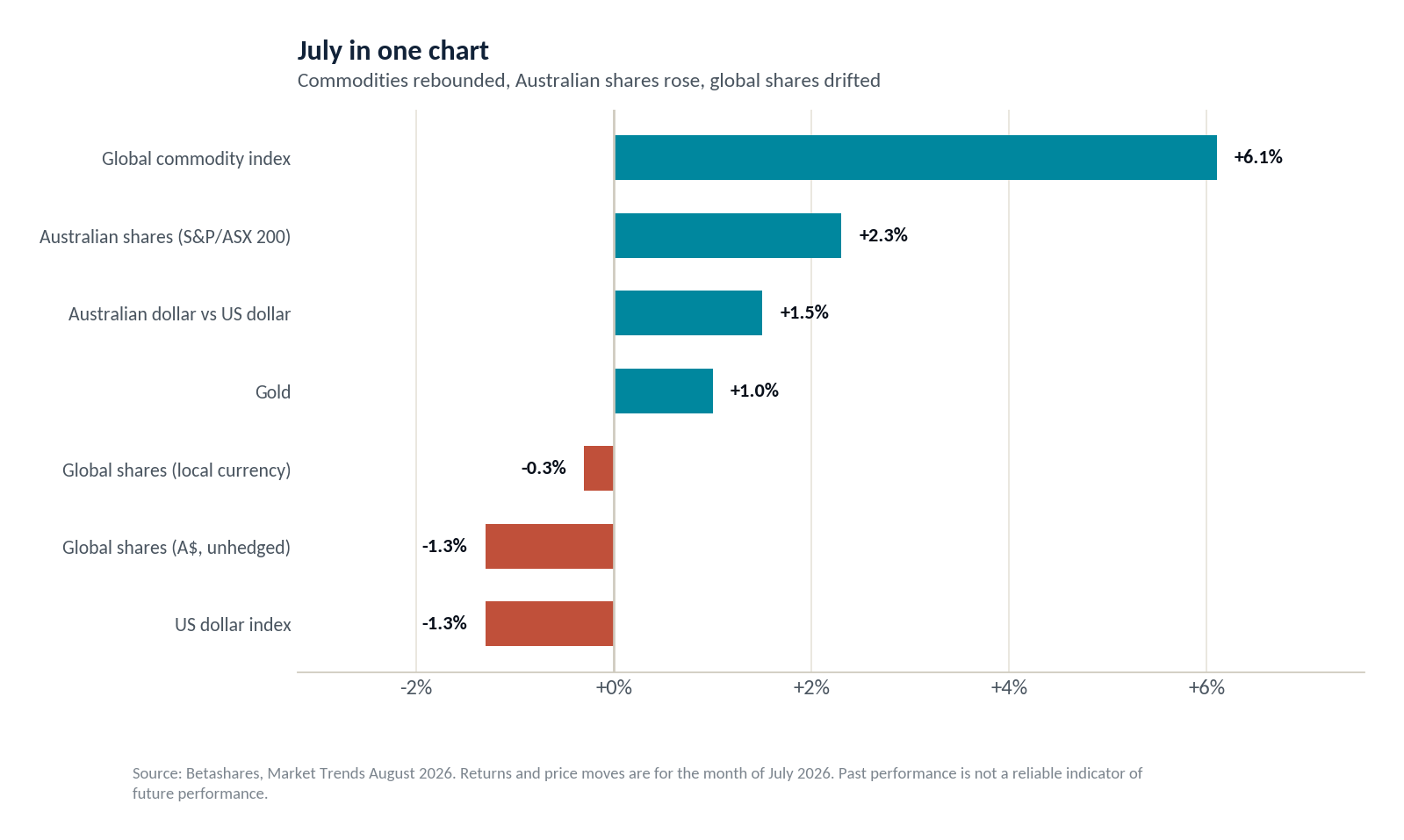
July was a month of divergence rather than direction. Australian shares rose, global shares drifted slightly lower, and the biggest move came from commodities, which rebounded strongly after a weak June.
Since the month ended, the Reserve Bank has left the cash rate unchanged at 4.35% at its August meeting — the second hold in a row, after three increases earlier in 2026.
Interest rates
Bond yields moved in opposite directions in the two markets that matter most to Australian portfolios.
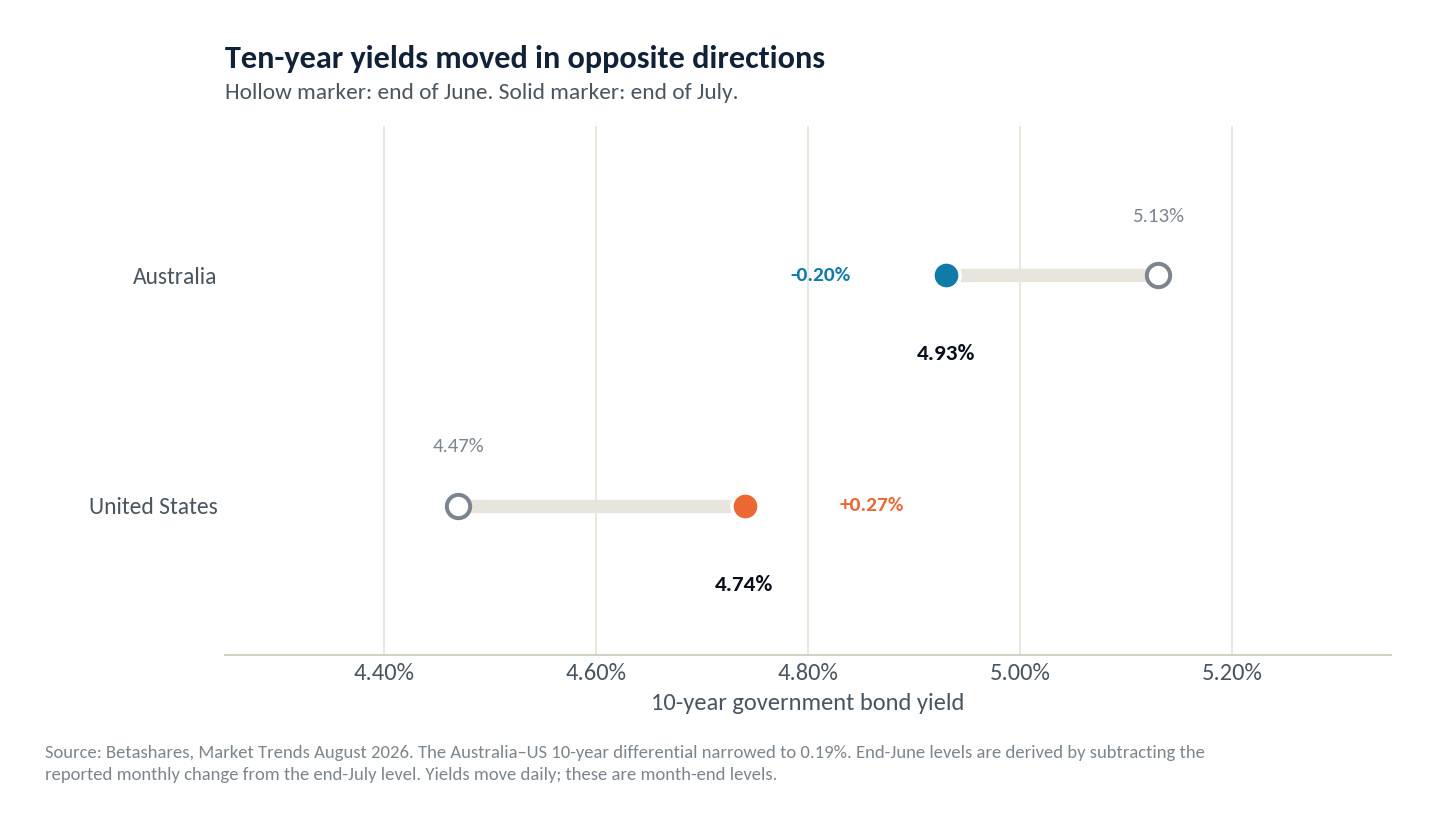
Australian 10-year government bond yields eased 0.20% over July to 4.93%. US 10-year yields rose 0.27% to 4.74%. The result is that the gap between them narrowed to 0.19%, with Australian yields still the higher of the two.
Yields in both markets have trended modestly higher since late 2025, reflecting a shift in expectations from rate cuts to the possibility of further increases. Markets are currently pricing around 0.3% of additional policy tightening in the United States by the end of 2026, and around 0.12% in Australia — small numbers, but a change in direction from where expectations sat a year ago.
The RBA's August decision to hold at 4.35% was accompanied by language indicating that headline and underlying inflation remain above the 2–3% target band, and that the Board would consider a further increase if upside risks materialise. Financial conditions have tightened following the three increases earlier in the year, and consumer spending is slowing broadly as the Bank expected.
For anyone with a mortgage, the practical point is unchanged: the cost of debt is materially higher than it was two years ago, and the Bank has not signalled that it is about to fall.
Commodity prices
Commodities were the standout of the month. The benchmark index of global commodity prices rose 6.1% in July, reversing most of June's 7.5% decline. Oil and LNG led the rebound.
That matters beyond the resources sector. Energy prices feed directly into headline inflation, and a sustained rebound complicates the path back to the target band — which is part of why bond markets have shifted from pricing cuts to pricing the possibility of increases.
Gold gained 1% over the month. That it held its ground while bond yields rose is mildly notable, since higher yields usually work against an asset that pays no income.
Exchange rates
The US dollar index eased 1.3% in July. The Australian dollar firmed 1.5% against the US dollar, finishing the month at US70.2 cents.
Currency is doing real work in portfolio returns at the moment. Global shares fell 0.3% in local currency terms over July, but an Australian investor holding them unhedged saw a 1.3% fall — the difference being the stronger Australian dollar. Over longer periods that effect compounds in both directions, which is why the hedging decision deserves more thought than it usually gets.
Global equities
Global equity returns dipped a further 0.3% in July in local currency terms, and 1.3% in unhedged Australian dollar terms.
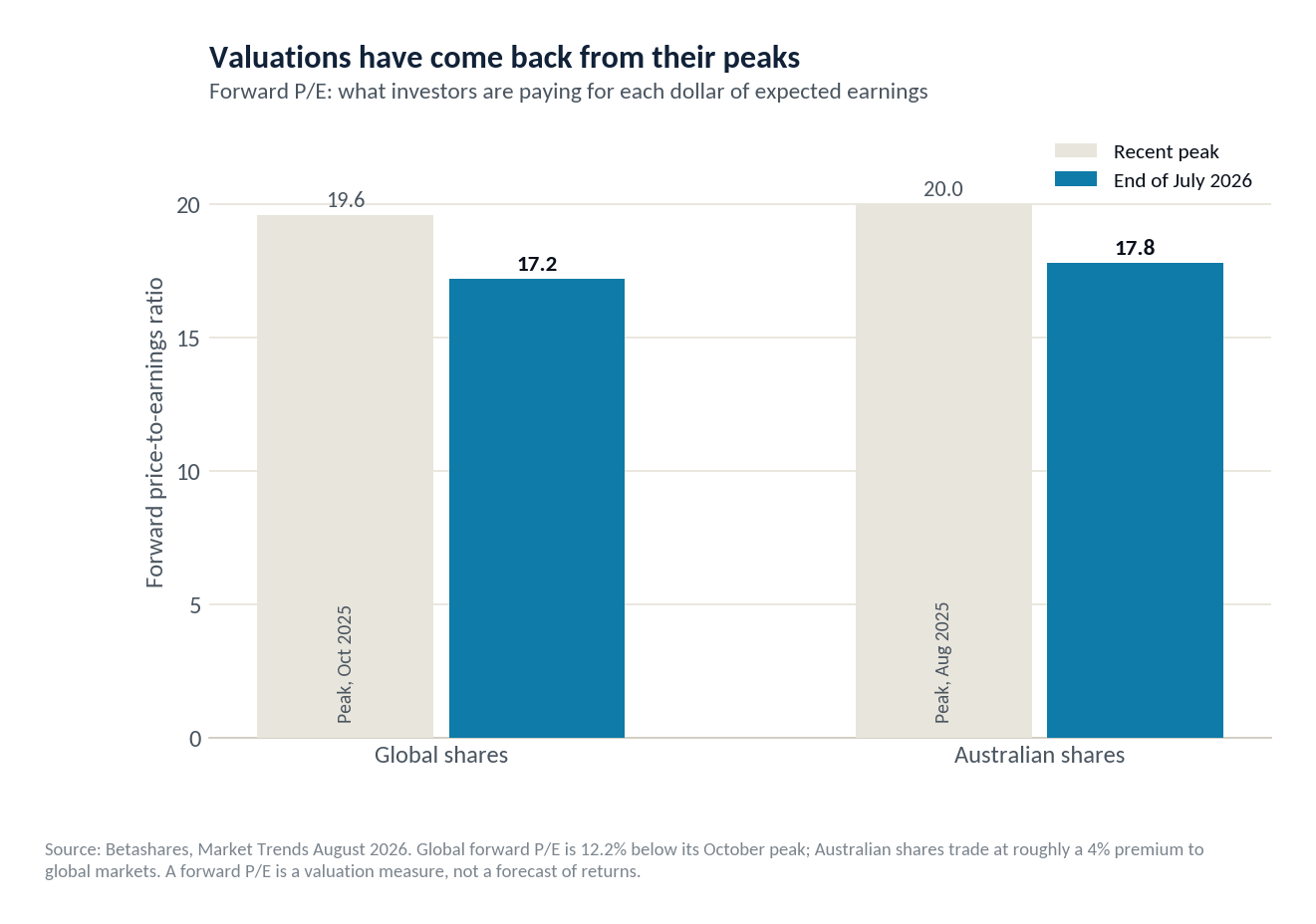
Valuations continue to ease. The forward price-to-earnings ratio for global shares finished July at 17.2, some 12.2% below its October peak of 19.6. The reason is worth being precise about. Prices rose over the period, but earnings rose considerably faster — forward earnings are up 27.5% — which allowed valuations to fall even as the market advanced.
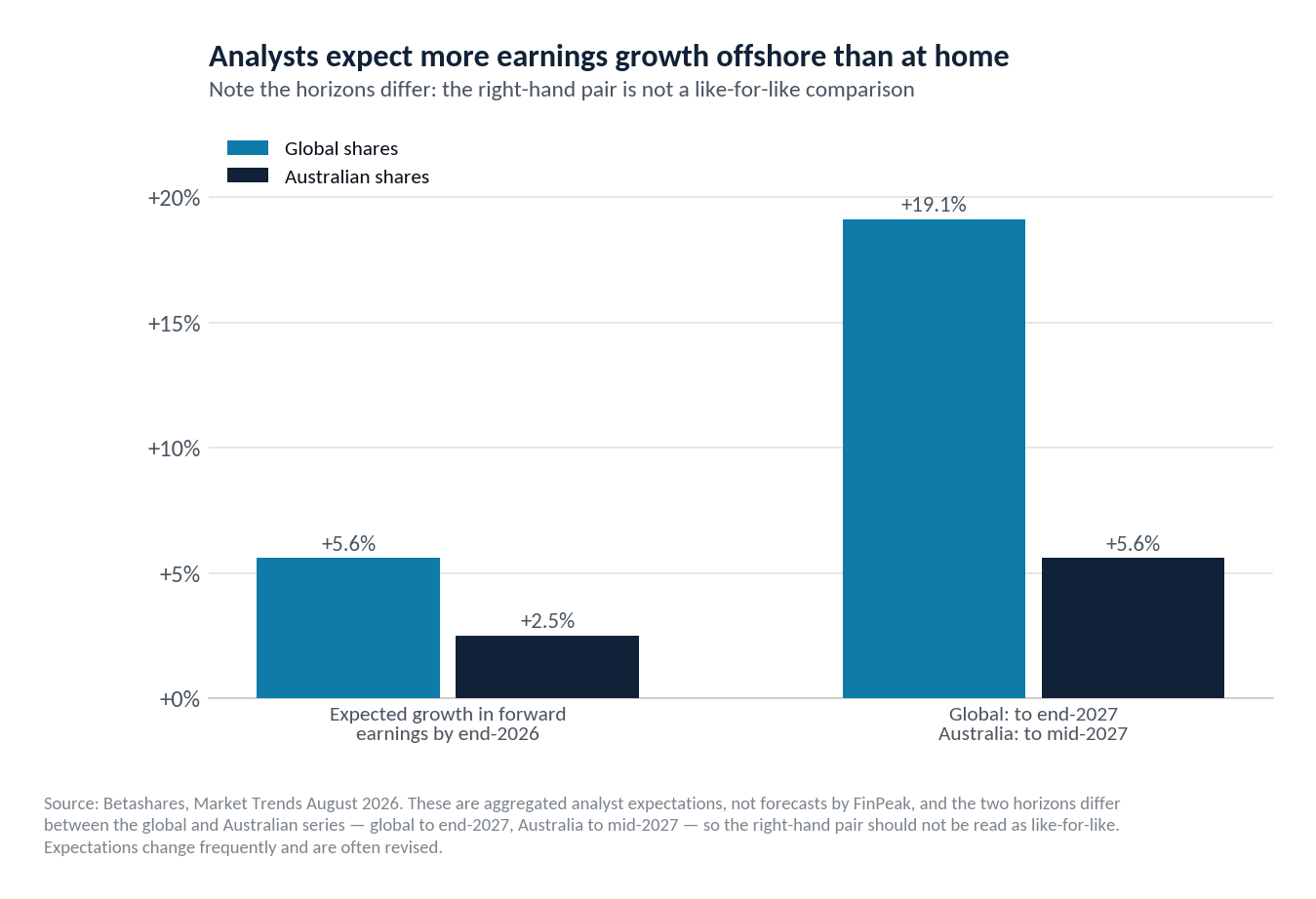
On the analysts' numbers, global forward earnings are expected to grow a further 5.6% by the end of 2026 and 19.1% by the end of 2027.
Australian equities
Australian shares lifted further in July, with the S&P/ASX 200 returning 2.3%, following a 0.7% gain in June. Energy and financials were the standout sectors — consistent with the commodity rebound and with a banking sector reporting solid results.
The Australian market's forward P/E finished July at 17.8, around a 4% premium to global markets, and below its recent peak of 20 reached in August last year.
Expected earnings growth is the more sobering number. Australian forward earnings are expected to grow 2.5% by the end of 2026 and 5.6% by the middle of 2027 — considerably less than the growth expected offshore.
That gap is largely structural. The Australian index has around a third in financials and close to 30% in materials and energy combined, with only a small technology weighting. It is a different mix of businesses, not simply a worse one, and it behaves differently through the cycle.
What this means for portfolios
A few observations, offered as context rather than as a call to act.
- Markets have shifted from pricing cuts towards the possibility of modest further tightening. The amounts involved are small — around 0.12 percentage points in Australia and 0.3 in the United States by the end of 2026 — and the RBA's August Statement notes that the implied Australian rate path has actually fallen since May. It is a change in direction, not a step change in level.
- Cash and short-duration fixed interest are offering meaningful nominal yields again. For anyone holding a defensive allocation, that is a genuine change from the last decade — and a reason the offset account and term deposits are stronger competitors for surplus cash than they have been. Whether the return is positive after inflation and tax depends on the particular investment and your own position; the RBA still describes inflation as too high.
- Valuations are less stretched than they were. Global forward P/Es have come back meaningfully from their peak, because earnings outgrew prices rather than because prices fell. That is the healthier of the two ways for a valuation to normalise.
- Currency is not a side issue. A 1.5% move in the Australian dollar in a single month is larger than the underlying equity move it sat alongside. Whether offshore holdings are hedged is a live decision.
- The earnings gap between Australian and global shares is worth understanding. It is a reason to hold both, not a reason to abandon either.
None of this argues for changing a well-constructed portfolio. Month-to-month moves are noise against a plan measured in decades. The purpose of a monthly review is to keep you informed, not to prompt action.
The bottom line
July delivered a modest gain for Australian shares, a small decline for global shares, and a sharp rebound in commodities. The RBA held rates in August but has not ruled out further increases. Valuations have eased from their peaks, mostly because earnings grew faster than prices, and the defensive part of a portfolio is finally earning a meaningful yield again.
The environment asks more of a portfolio's construction than it did five years ago, when almost everything worked. That is an argument for reviewing how yours is put together — not for reacting to any single month.
Speak with an adviser
If you'd like to understand how your portfolio is positioned against this backdrop, or you're carrying more cash than you intended and aren't sure where it should sit, it may be worth reviewing your position before making changes.
Important information
This article is general information only. It has been prepared without taking into account your objectives, financial situation or needs, and should not be relied on as personal financial advice. Past performance is not a reliable indicator of future performance. Index returns do not include the fees, costs or taxes that would apply to an actual investment, and do not represent the return of any FinPeak portfolio. Market data referenced in this update is drawn from third-party commentary and public sources current at the time of writing, and market expectations described are those of third parties, not FinPeak. FinPeak Advisers is a Corporate Authorised Representative (1249766) of Spark Advisors Australia (AFSL 380552).