
There's an awkward asymmetry in most household balance sheets. The mortgage on the home is usually the largest debt, and it's the one form of borrowing where the interest earns you nothing back at tax time. Every repayment comes from income you've already paid tax on.
At the same time, many of the same households are trying to build investments alongside the mortgage. So you end up running two things at once: paying down expensive, non-deductible debt with after-tax dollars, and slowly assembling a portfolio on the side.
Debt recycling is a way of joining those two projects together. It is not a new idea, and it rests on long-standing ATO principles about the use of borrowed funds, redraws and interest deductibility. What has changed this year is the tax environment around it — and the change is more specific than the headlines about negative gearing suggest.
What debt recycling actually is
Debt recycling converts non-deductible debt into deductible debt, gradually, without increasing what you owe overall.
The principle it relies on is simple. In Australia, interest is deductible based on what the borrowed money is used for, not on what the loan is secured against. Borrow to buy the home you live in, and the interest is not deductible. Borrow to buy assets that produce assessable income, and it generally is — even if the security for that loan is still your house.
So the strategy is not about borrowing more. It's about changing the character of the debt you already have.
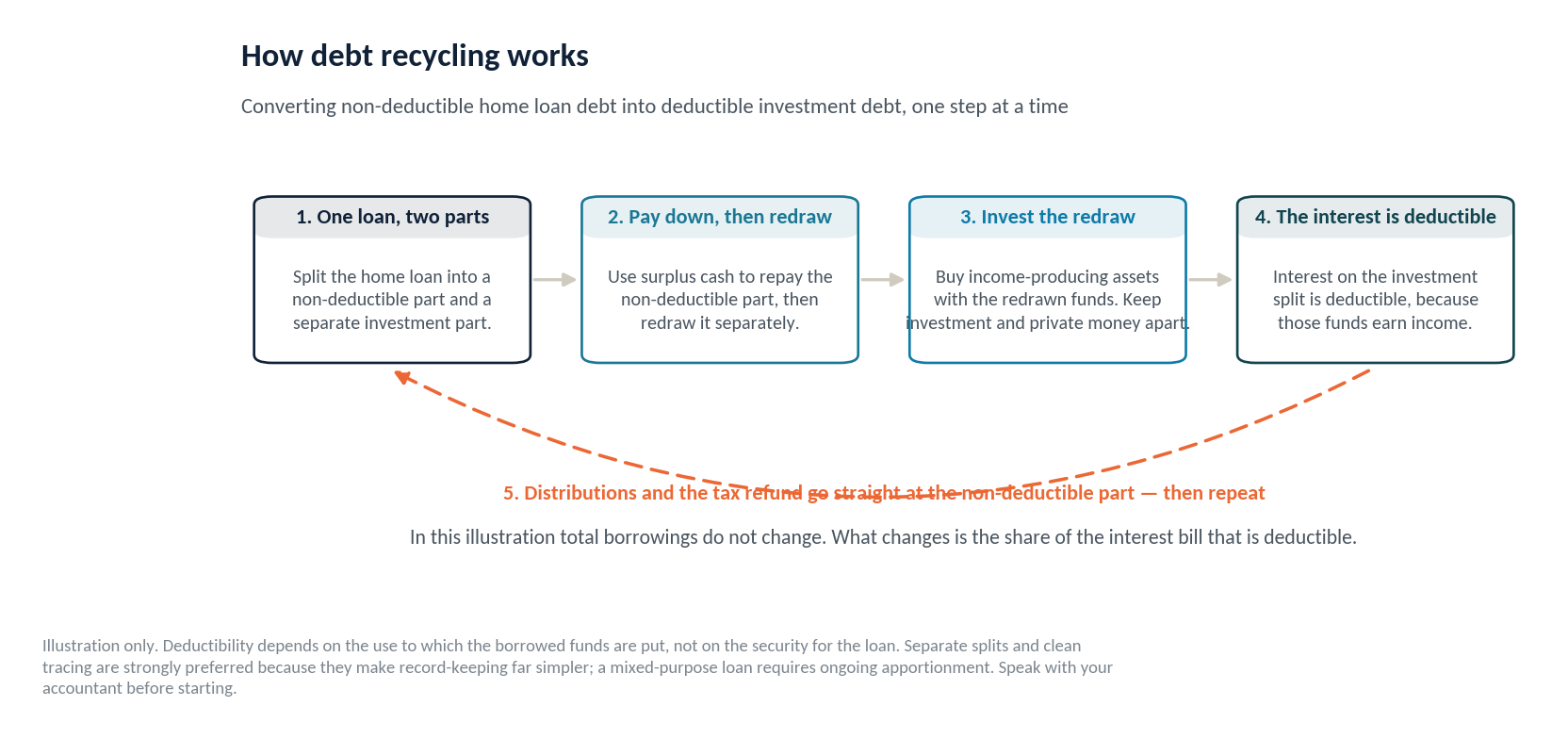
How it works, step by step
- 1. Split the loan. Your lender divides the home loan into two sub-accounts. One stays as the home portion. The other is the split you intend to recycle. Separate splits are not simply tidier — they are what makes the strategy work. Inside a single mixed-purpose account the debt is treated as one undivided sum, and repayments are apportioned across the private and investment portions rather than directed at the private part. The ATO does recognise mixed-purpose accounts and provides for apportionment, so a mixed loan is not fatal to a deduction; but the method described here depends on having genuinely separate splits.
- 2. Repay, then redraw. Surplus cash is used to reduce the balance of the split you intend to recycle. The same amount is then redrawn from that same split. Because a redraw is treated as a new borrowing, keeping the repayment and the redraw within the one split is what preserves a clean connection between the borrowing and what it funds.
- 3. Invest the redraw. Those redrawn funds buy income-producing assets. Best practice is to move the money directly from the investment split to the investment, or to a dedicated investment cash account, and to keep it away from private funds. Deductibility follows the use of the redrawn money, so the cleaner the trail, the easier the position is to support.
- 4. The interest becomes deductible. Because those borrowed funds are producing assessable income, the interest on that split is generally deductible.
- 5. Point the proceeds back at the home loan. Distributions from the portfolio, and any tax saving attributable to the deduction, go straight at the remaining non-deductible balance. Then you repeat.
Each cycle shifts a slice of debt from the non-deductible column to the deductible one. In a good year the cycles get larger, because distributions and refunds are feeding back into them — but that is not guaranteed. Distributions can fall, and the refund depends on the deduction and on your income in that year.
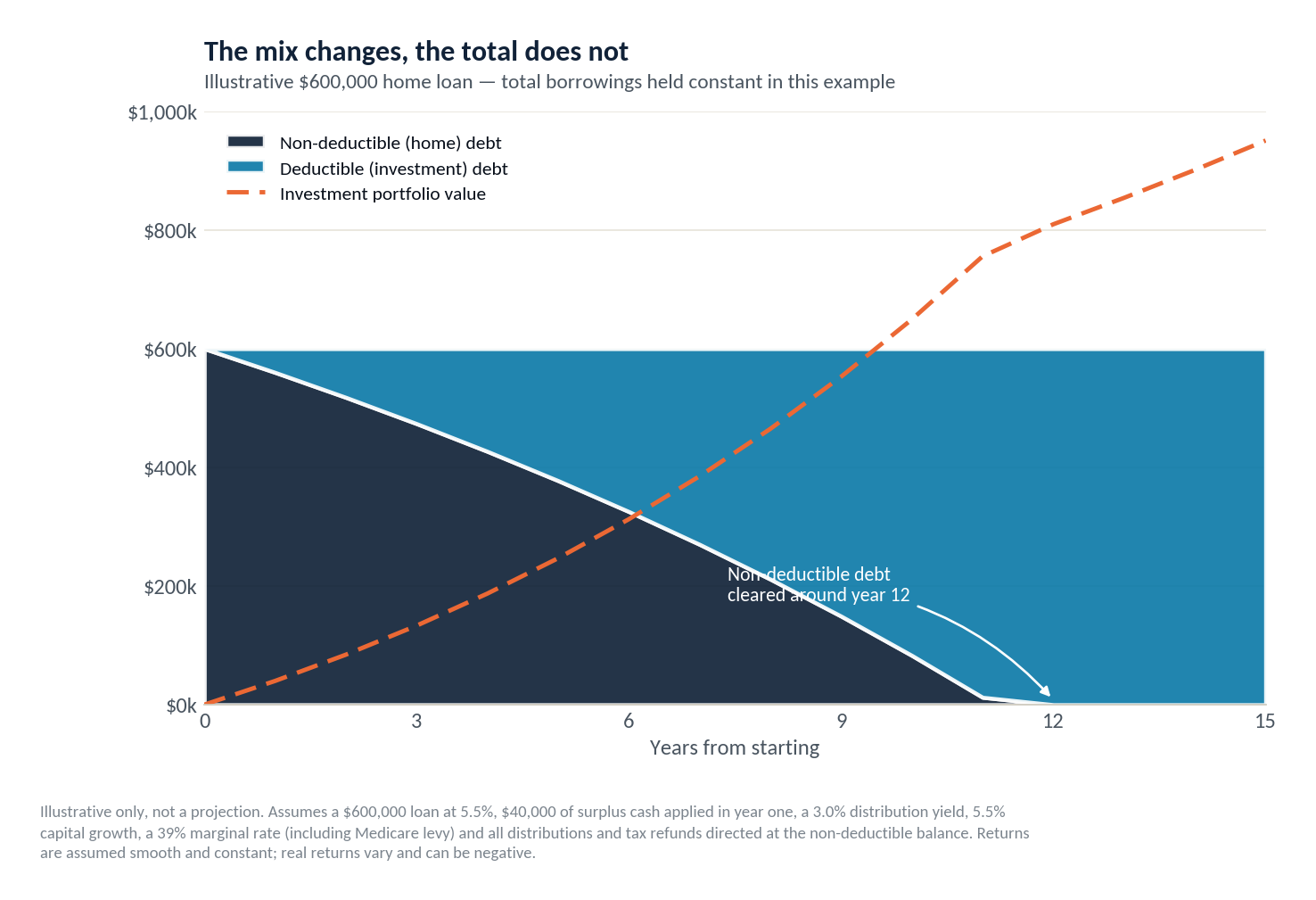
Notice what the chart does not show: total borrowings rising. That is an assumption of the illustration rather than a law of the strategy — a standard recycling transaction need not increase what you owe, and in practice the balance often falls as scheduled repayments and other cash flows come through. What changes is the proportion of the interest bill you can claim, and the fact that you now own a portfolio you didn't have before.
What the 2026 reforms changed
This is where the picture has genuinely shifted, and where a lot of the commentary has been imprecise.
Two reforms were legislated this year and apply from July 2027. The first narrows negative gearing. The second replaces the 50% capital gains tax discount with cost base indexation and a minimum 30% rate of tax on the gain. Both received Royal Assent in June 2026, though some implementation detail is still being settled through further instruments. Neither is retrospective, and neither bites yet.
The important detail is scope.
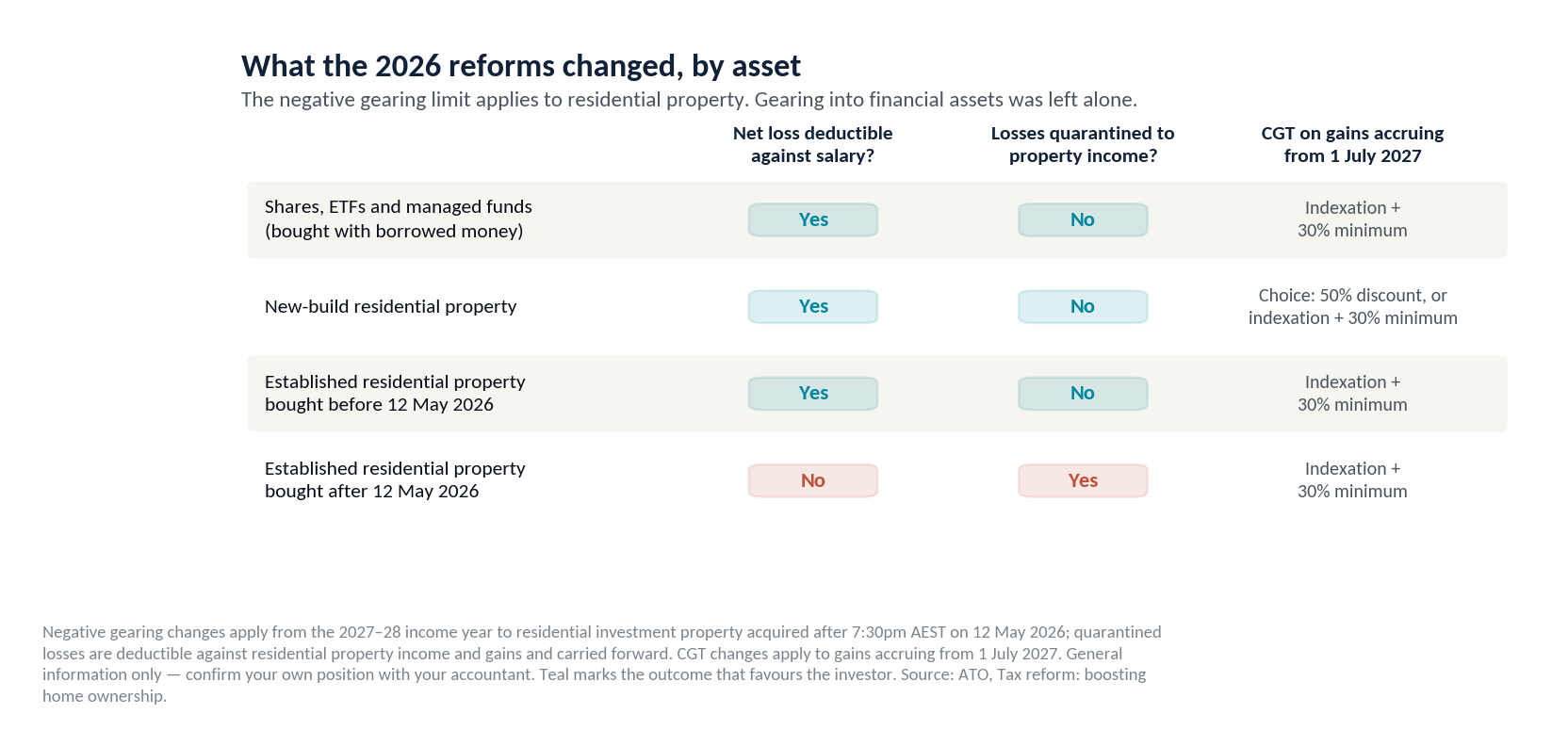
The negative gearing limit is a residential property rule. From the 2027–28 income year, net rental losses on established residential property bought after 7:30pm AEST on 12 May 2026 are quarantined. They can be offset against residential property income and gains, and carried forward, but not against your salary. New builds are excluded from the limit, as are properties held before Budget night.
Gearing into shares and managed funds was not touched. If you borrow to buy income-producing financial assets and the interest exceeds the distributions, that net loss remains deductible against your other income in the ordinary way. The reform simply doesn't reach it.
That difference matters for debt recycling, because debt recycling is almost always done into financial assets rather than property. The mechanism it depends on is intact.
The CGT change does apply to shares. Gains that accrue from 1 July 2027 on assets held personally will be worked out using cost base indexation, with a minimum rate of tax of 30% applying to the gain, rather than the 50% discount. As with the discount it replaces, the indexation regime generally requires the asset to have been held for at least 12 months. Gains accrued before that date keep the old treatment.
Which assets look different now
The reforms haven't made debt recycling better or worse in a general sense. They've changed the relative appeal of what you hold inside it.
- The income side of a return is worth relatively more. The tax treatment of dividends and franking credits is unchanged. The treatment of long-run capital growth held personally has changed materially, though not uniformly for the worse — Treasury's own position is that some investors will pay less under indexation than under the discount, depending on inflation, the holding period and the return. What is more certain is the cash flow: a reliable, franked income stream is what funds the next recycling cycle, and that argument does not depend on how the capital gains arithmetic lands.
- Franking still does real work. Franking credits reduce the tax on distributions, and eligible excess credits remain refundable under the usual rules. That hasn't changed.
- Established residential property is a poor fit, and now more so. It was always awkward for recycling — lumpy, illiquid, hard to buy in instalments. Now, if bought after Budget night, its losses can't offset salary either.
- Where an asset sits matters more than it used to. The same gain is taxed differently in your own name, jointly, in a trust, inside super, or in a company. The reforms widened those gaps. Debt recycling does not belong to any one structure, but it does require several things to line up: who borrows, who owns the asset, who receives the assessable income, and what the borrowed funds are used for. Get those out of alignment and the deduction may not sit where you expect it to.
- Keep records supporting the position of your holdings at 1 July 2027. The pre- and post-reform components of a gain are split at that date, and the transition mechanics are technical. Retain records that support the value and tax treatment of each holding at the transition date. The method for calculating gains either side of the transition was still being settled through consultation at the time of writing, so check the position before relying on any particular approach.
The risks, plainly
Debt recycling is a geared strategy. That deserves to be said clearly rather than buried.
- Leverage magnifies losses as well as gains. The debt is fixed. The value of what you bought with it is not. A portfolio can fall while the loan stays exactly where it is.
- The deduction is only worth what your tax rate makes it worth. On a lower marginal rate, the benefit is much smaller, and the risk is unchanged.
- A deduction is not a return. The interest is a real cost. Deductibility reduces it; it doesn't remove it.
- Sloppy mechanics can materially compromise the claim. If private and investment borrowings end up in the same account, the loan becomes mixed purpose. That doesn't automatically destroy the deduction — only the income-producing proportion of the interest is deductible. But the proportion has to be worked out and maintained, repayments are then apportioned across both parts rather than able to be directed at the private portion, and a weak trail is difficult to defend if the claim is ever examined.
- It is not the same as an interest-capitalising arrangement. The strategy described here uses real surplus cash, and directs distributions at the remaining non-deductible balance. That is different from arrangements that borrow to pay the interest on an investment loan so that the interest capitalises, while cash flow is directed at the home loan instead. The ATO has said the general anti-avoidance rule can apply to those, and the High Court has applied it to a comparable structure. Whether any particular arrangement is affected depends on its own facts.
- Rates move. The strategy is more sensitive to your loan rate than most people expect, because the loan rate sets the bar the portfolio has to clear.
- It competes with simply paying the loan down. Repaying non-deductible debt produces a certain after-tax saving equal to your loan rate, for as long as that rate applies. That is a genuinely strong alternative, and for some people it is the better one.
What to check before you start
A short list to work through — with your adviser and your accountant together, not separately:
- Is your loan actually splittable, and what will your lender charge to do it?
- Do you have surplus cash that is genuinely surplus, after an emergency reserve?
- What is your marginal tax rate, and is it likely to stay there? A strategy built around a 47% rate looks different at 32%.
- Could you hold the position through a 30% fall in the portfolio without needing to sell?
- Who is keeping the records, and how? This is the step people underestimate.
- Have you compared it honestly against the alternatives — paying the loan down, or contributing to super?
- Does your accountant agree with the structure before the first dollar moves, rather than after?
The bottom line
Debt recycling is a mechanical strategy, not a clever one. It converts debt you already have from a non-deductible form into a deductible one, using money you were going to put toward the mortgage anyway. It works because of a long-standing principle about the purpose of borrowed funds, and that principle survived this year's reforms intact.
What the reforms did change is the relative appeal of the assets you might hold. Financial assets kept their deductibility. Established residential property, bought from Budget night onward, did not. And long-run capital growth held in your own name is now taxed on a different basis, with the outcome depending on inflation, holding period and return.
None of that makes the strategy right for you. It is geared, it requires discipline, and it is unforgiving of administrative mistakes. It suits people with secure surplus income, a meaningful marginal tax rate and the temperament to hold through a bad year. If that isn't a fair description of your position, paying the loan down is not a lesser option — it's just a different one.
Speak with an adviser
If you're carrying a substantial non-deductible mortgage and building investments alongside it, it may be worth reviewing how the two fit together before making changes. We can help you model the alternatives and coordinate the conversation with your accountant. Where new or restructured lending is involved, we work with finance partners who can look at the loan side.
Important information
This article is general information only. It has been prepared without taking into account your objectives, financial situation or needs, and should not be relied on as personal financial or tax advice. Debt recycling is a geared strategy and is not suitable for everyone. Borrowing to invest magnifies both gains and losses. Tax outcomes depend on your individual circumstances, and the deductibility of interest depends on the specific facts of your arrangement — we'd recommend speaking with your accountant or registered tax agent, as well as your financial adviser, before acting on anything above. Any figures shown are illustrations only, not projections, and assume smooth constant returns that do not occur in practice. FinPeak Advisers is a Corporate Authorised Representative (1249766) of Spark Advisors Australia (AFSL 380552).