
As at 13 October 2026.
Four rate rises in a year change a household’s arithmetic. The cash rate is 4.60%, up a full percentage point since January. The Reserve Bank’s next decision is due on 3 November. As at 7 October, Betashares put the odds of a move that day at about one in five, with roughly one more increase priced over the coming year; that is market pricing on one date, not a prediction. At the same time petrol, diesel and freight costs are rising with oil above US$100 a barrel. The question this article asks is simple: if another rise comes, whenever it comes, is the buffer that absorbed the first four still there?
It is a check you can do in an evening, whichever way the November decision goes.
What one more 0.25 points costs
On a 25-year principal-and-interest loan at a variable rate of 6.5%:
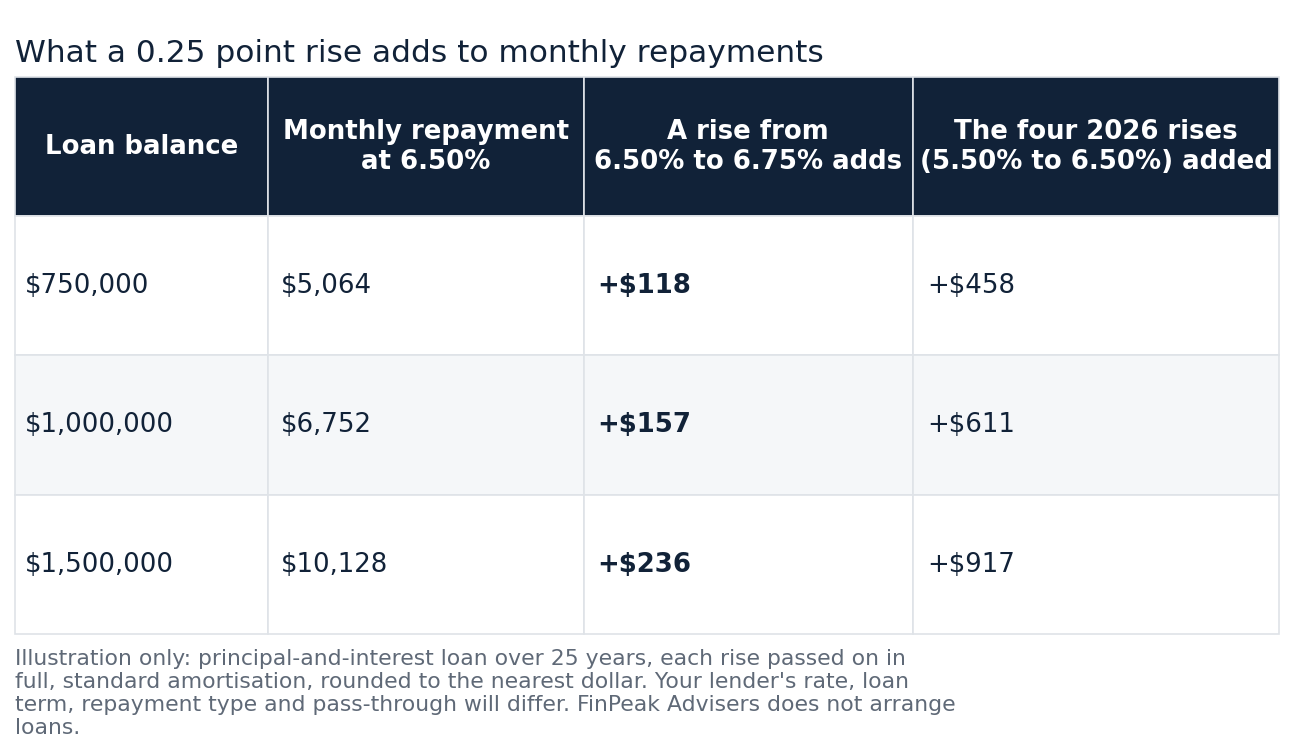
- $750,000: about $118 a month more for a rise from 6.50% to 6.75%. The year’s four rises, if passed on in full, added about $458 a month.
- $1,000,000: about $157 a month more. The year so far: about $611.
- $1,500,000: about $236 a month more. The year so far: about $917.
Your own rate, loan term and whether you are on interest-only will move these numbers, and lenders do not always pass rises on in full or at once. Each 0.25 point step also adds slightly more than the last, because it compounds on a higher rate. The point is the order of magnitude: one more rise is a modest monthly amount on its own; the year’s rises together are a meaningful one.
The buffer question
When you took out or last refinanced your loan, the lender tested whether you could afford repayments at a rate well above the one you were offered. APRA’s serviceability buffer, 3 percentage points above the loan rate, has applied since 2021 so that a cycle like this one does not break household budgets.
That buffer is an assessment assumption, not evidence that you have spare cash. It was tested on your income and expenses at the time, and three things erode it:
- Rate rises consume it. A loan written at 5.5% was tested at 8.5%. Four rises have used a third of the margin.
- Life changes consume it. A second child, a move to part-time, school fees starting, a partner between roles.
- Costs rise around it. Fuel rose 14.8% in a month on the latest CPI release, and insurance, energy and groceries have all moved.
Some lenders now assess like-for-like refinances on a buffer of 1 percentage point rather than 3, which widens what you can qualify for. Our finance partners described that shift in last month’s issue. Treat it with some care: a lower buffer means a lender will approve more, not that you should take it.
A six-line cash-flow check
Do this with your last three months of bank statements, not your memory.
1. Repayments at today’s rate, plus 0.25 points, plus another 0.25. Three numbers.
2. Fixed commitments that do not move with rates: school fees, insurance, car, childcare, the investment property’s shortfall if you have one.
3. Variable spending over the three months, averaged. Be honest about the categories that have crept.
4. Income after tax, including anything irregular you rely on, such as bonuses, with a note on how reliable it is.
5. Surplus or shortfall at each of the three repayment levels.
6. Buffer in months. Offset and savings balances divided by monthly outgoings.
If line 5 is positive at the third level and line 6 is above three, those results suggest some breathing room. The buffer you need also depends on how stable your income is, who depends on it and what expenses are coming. If line 5 turns negative or line 6 is under two, keep reading.
Offset, paying down, or investing
Every dollar in an offset account against a 6.5% home loan saves interest at 6.5%, after tax and without market risk. That is a high bar for any investment to clear after tax, and it rises with every rate increase. For most people in the current cycle, surplus cash into the offset is the sensible default.
One thing an offset does not do: on a principal-and-interest loan it reduces the interest you pay, but it generally does not reduce the repayment the lender requires each month. The saving shows up as faster progress on the loan, not as a smaller direct debit. So an offset builds your buffer and cuts total interest; it does not, on its own, fix a monthly shortfall. Money in an offset can be withdrawn when you need it. Paying the loan down directly achieves the same interest saving but gives up that flexibility, because getting extra repayments back means applying for redraw, and not every loan allows it.
Investing surplus instead of offsetting makes sense when the expected after-tax return comfortably exceeds the loan rate and the money is not needed for the buffer. At 6.5% and rising, that case is narrower than it was two years ago, which is why the hurdle-rate article we published in August is worth re-reading now.
Fixed, variable or split
Fixing a rate buys certainty, not savings. Fixed rates already price the market’s expectation of future moves, so fixing now means paying today for protection against increases the market already expects. If rates then fall, the fixed borrower pays more; if they rise further than expected, the fixed borrower is better off. Fixed loans also usually limit extra repayments and offset use.
A split loan, part fixed and part variable, is a hedge rather than a bet. Whether any of this suits you depends on your buffer, your income stability and how much you value certainty. We do not arrange loans; where a change to your lending is worth exploring, we coordinate it with finance partners alongside your broader plan.
Where a bonus or refund should go
A tax refund or year-end bonus arrives at a useful time. The order of operations when cash is tight is usually: top the buffer up to three months, clear any debt costing more than the home loan (credit cards, car finance, and since 1 July 2025 any ATO debt, on which interest is no longer deductible), then the offset. Super contributions and investing come after, not before, unless your buffer is already full and you are confident it stays that way.
If it does not add up
If the check shows a shortfall at the next rise, act before the decision rather than after it. Options, roughly in order of how much they change:
- Trim variable spending. The only lever that is entirely yours.
- Review the loan. A repricing or refinance through a finance partner may lower the rate; the 1-point refinance buffer some lenders now use makes this available to more households than a year ago.
- Interest-only for a defined period. This lowers the monthly repayment, but the trade-off is real: the principal does not reduce during the period, total interest over the life of the loan is higher, and repayments step up, sometimes sharply, when the period ends. It buys time; it does not reduce the debt.
- An investment property’s shortfall. If it is now larger than the household can carry, that is a planning conversation, not just a lending one.
- Talk to the lender early. Lenders have hardship processes and respond better to early contact than to a missed payment.
The bottom line
Another rise is a possibility, not a certainty, and the November decision could go either way. One rise on its own is manageable for many households; it is the cumulative year, with higher fuel and insurance costs on top, that has thinned buffers. Spend an evening on the six-line check. If it comes up comfortable, you have done your homework. If it does not, there is time to do something about it.
Speak with an adviser
If this affects you, it may be worth reviewing your position before making changes. We can go through the check with you, test it against your plan, and coordinate with finance partners where your lending needs a look.
Important information
This article is general information only, current as at 13 October 2026. It has been prepared without taking into account your objectives, financial situation or needs. Before acting on any information, consider whether it is appropriate for you and seek advice tailored to your circumstances. Repayment figures are illustrations at an assumed 6.5% variable rate over 25 years; your lender’s rate and terms will differ. Market pricing of future interest rate movements is attributed to the source named, is as at the date stated, and is not a prediction. FinPeak Advisers does not provide credit advice or arrange loans; lending is coordinated through finance partners. Tax outcomes depend on individual circumstances; speak with your accountant or registered tax agent. FinPeak Advisers ABN 20 412 206 738 is a Corporate Authorised Representative No. 1249766 of Spark Advisors Australia Pty Ltd ABN 34 122 486 935 AFSL No. 380552 (a subsidiary of Spark Financial Group ABN 15 621 553 786).
Sources: RBA, Statement by the Monetary Policy Board, 29 September 2026, and 2026 meeting dates; Betashares, Market Trends: October 2026 (7 October 2026; one-year-ahead implied cash rate about 4.9% and about a 20% probability of a November move); ABS, Monthly CPI August 2026 (30 September 2026); APRA, macroprudential policy settings (serviceability buffer of 3 percentage points); ASIC, Check your mortgage offset account is actually saving you money; Moneysmart, Interest-only home loans; ATO, general interest charge deductibility from 1 July 2025; FinPeak Insights, What lenders are doing differently after the Budget (September 2026) and Offset, Invest or Super? Start With the Hurdle Rate (August 2026). Repayment arithmetic: FinPeak, standard amortisation at 6.5% over 25 years.